
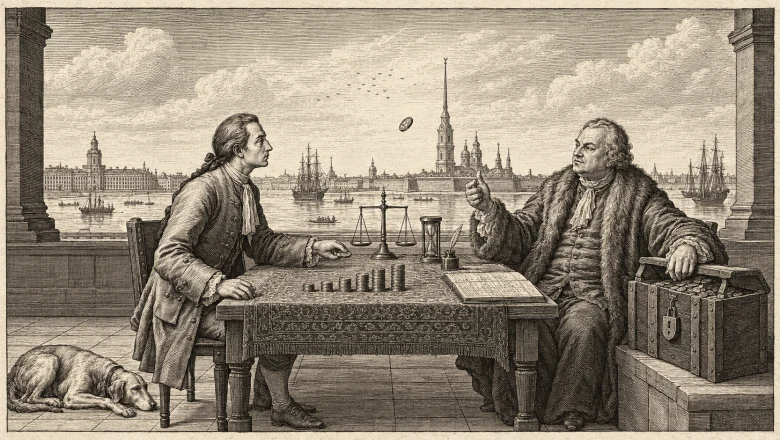
Two people are playing: Peter and Paul. Peter tosses a coin until it lands heads. If heads comes up on the first toss, Peter pays Paul 1 ducat. If on the second, 2 ducats. If on the third, 4 ducats. And so on: every toss without heads doubles the payout. Paul pays Peter in advance for the right to play. This is the form in which Daniel Bernoulli studied the game in his paper of 1738.
Imagine that Paul is you. How much would you pay Peter for a single game? Answer right away, in ducats, and remember your answer: you will need it at the end of the article. For now, let us assume that 1 ducat equals $10. What a ducat is really worth is in the spoiler after the first paradox.
18 th‑century mathematicians calculated the price of this game by correct rules and got an answer they themselves found absurd. This is the paradox. The dispute over where the error lies lasted almost three hundred years and led to three more paradoxes. Four future Nobel laureates took part in it.
The problem of Nicolaus Bernoulli
The game is often attributed to Daniel Bernoulli (1700–1782). In fact it was invented by his cousin Nicolaus, and Daniel proposed the solution that made the problem famous.
On 9 September 1713, Nicolaus Bernoulli (1687–1759) wrote from Basel, Switzerland, to the French mathematician Pierre Rémond de Montmort (1678–1719), the author of one of the first books on probability in games of chance. The letter contained several problems with a die. In one of them A promises B one écu if B throws a six on the first throw, two écus if on the second, three if on the third, and so on. In the next problem Nicolaus asks the same question for payouts of 1, 2, 4, 8, 16 and for other progressions. The Genevan mathematician Gabriel Cramer (1704–1752), the Cramer of Cramer’s rule for systems of linear equations, analysed the game with doubling payouts in a letter to Nicolaus Bernoulli from London dated 21 May 1728, this time with a coin instead of a die. Daniel also studied it with a coin. From 1725 to 1733 he worked at the St. Petersburg Academy of Sciences, and in 1731 he submitted his paper to it. The paper appeared in 1738 in the fifth volume of the Academy’s journal, “Commentarii Academiae Scientiarum Imperialis Petropolitanae” (“Commentaries of the Imperial Academy of Sciences in St. Petersburg”). The game is named St. Petersburg after the journal. It was invented, as we see, in Basel.
By training Nicolaus was not only a mathematician but also a lawyer, a doctor of law: in 1709 he defended a dissertation on applying probability theory in court. Today Basel is familiar to financiers from the Basel Accords, which set how much capital a bank must hold against losses. For the game from the letter Nicolaus sent from Basel, no amount of capital would be enough.
The first paradox: an infinite average and twenty ducats
An 18 th‑century mathematician would have answered the question about the price like this: the game is worth as much as it pays on average. This average is called the expected value. To find it, you multiply each payout by its probability and add the results.
The probability of heads on the first toss is 1/2. For heads to come up first on the second toss, tails must come first and then heads, and the probability of that is half as large: 1/4. For the third toss it is 1/8, and so on. Let us write down the expected value:

In each term, the first factor is the probability of the outcome and the second is the payout. Every outcome contributes exactly half a ducat to the average, and there are infinitely many outcomes. Rare outcomes contribute as much as frequent ones. A game in which heads first comes up on the 21 st toss happens about once in two million games and pays 1,048,576 ducats, about 3.7 tonnes of gold. Yet it too adds the same half ducat to the average.
The conclusion suggests itself: for the right to play, Paul should give up his entire fortune, and even that is not enough. Yet no one in their right mind would do so. Nicolaus Bernoulli wrote to Daniel that “any fairly reasonable man would sell his chance, with great pleasure, for twenty ducats”. Cramer wrote the same from the other side: “no reasonable man would be willing to pay 20 ducats as equivalent”.
This is the first paradox, the one later named the St. Petersburg paradox: by the average the game is worth an infinite amount, while a reasonable person values it at less than twenty ducats. I will use the word paradox for every case in which a calculation by correct rules gives one answer, and experience, common sense or what can actually be done gives another. If your price is less than twenty ducats, you are on the side of common sense, together with Nicolaus Bernoulli and Cramer.
What a ducat is worth in grams of gold and in dollars
A ducat of that time was a gold coin weighing about 3.5 g: Dutch ducats, for example, were struck from gold of 986 fineness. Twenty ducats contain about 70 g of gold and at its mid-2026 price are worth about $9,000. One ducat, then, is worth about $450, not the $10 we agreed on at the start. [проверить цену на день публикации] A noticeable sum, but nothing compared to infinity.
Four hidden assumptions of the calculation
The rules of the calculation are correct, so at least one of its assumptions is wrong. Taking the average as the price, the mathematician relies on four assumptions:
If many games are played, the average payout per game approaches the expected value.
Every payout, however large, enters the average in full.
Every ducat is worth the same to the player, however many ducats he already has.
Peter will pay any amount.
The second paradox: the law of large numbers and Buffon’s experiment
The mathematician derived the first assumption from the law of large numbers. This law, too, first appeared in print in 1713: that year Nicolaus Bernoulli published “Ars Conjectandi” (“The Art of Conjecturing”), the book of his late uncle Jacob (1654–1705).
The Bernoulli family and disputes over priority
The Bernoullis were a family of mathematicians from Basel. In 1683 Jacob, calculating compound interest, arrived at the number  . His younger brother Johann (1667–1748) taught mathematics to Leonhard Euler (1707–1783). Johann’s son Daniel published “Hydrodynamica” in 1738, which describes the principle now called Bernoulli’s principle. Johann soon released a very similar “Hydraulica” and dated it 1732 so that priority would remain his. Priority was valued highly in this family.
In “Ars Conjectandi” Jacob proved the law of large numbers: the more trials, the closer the frequency of an event to its probability. It follows that over many games the average payout per game approaches the expected value, provided the game has a finite number of outcomes. Insurance and lottery calculations rest on this law: the outcome of one policy or one ticket is unknown, while the result of thousands is close to the average.
So in the same year the same man published a book with one of the main laws of probability theory and posed a problem to which that law does not apply: the St. Petersburg game has infinitely many outcomes, and its expected value is infinite.
If the calculation does not give a reasonable answer, you can simply play the game. The French naturalist Georges‑Louis Leclerc, Comte de Buffon (1707–1788), the author of the multi‑volume “Natural History”, did exactly that. At his request a child played 2,048 games (Buffon, naturally, chose a power of two), and the payouts came to 10,057 écus, 4.9 écus per game on average. The écu was a French coin; the unit does not affect the conclusion. Incidentally, Buffon described this experiment in “Essai d’arithmétique morale” (“Essay on Moral Arithmetic”, 1777), and in the same work he analysed the needle problem: it lets you estimate π by dropping a needle on a ruled floor.
Buffon recorded for each game the toss on which heads came up (figure 1). On average, the games that ended on the first toss bring in as much as those that ended on the second, third or hundredth: 1,024 écus per 2,048 games. This is the same half coin per outcome as in the expected value, multiplied by 2,048 games. Buffon’s games went no further than the ninth toss, so his sum was made up of nine terms instead of infinitely many.
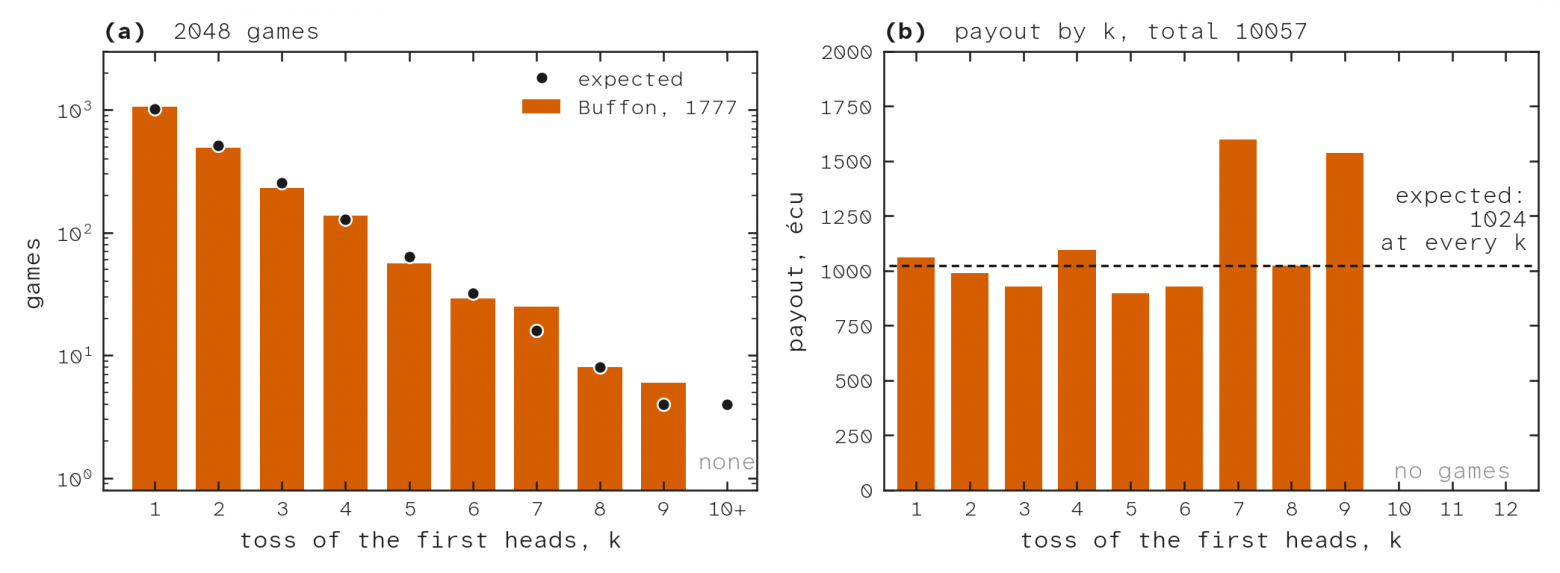
 : Buffon’s (bars) and the average (dots), logarithmic scale. Buffon has no games longer than nine tosses, while on average there are four. (b) Payout brought in by games with the first heads on toss . The dashed line shows the average payout: 1,024 écus for any .
Five écus per game looks like an answer. But how typical is this result? I repeated the experiment on a computer 400 times, now in ducats, and continued each series to 2,097,152 games (figure 2 a). In series of 2,048 games the median average payout is 7.1 ducats, and only 31 series out of 400 came out lower than Buffon’s. Buffon’s child was unlucky: 2,048 games contain on average four games longer than nine tosses, and he had none. This happens in about one series out of 55.
And what if the child had played not two thousand games but a million?
The answer was given in 1945 by the American mathematician William Feller (1906–1970), the author of the classic textbook “An Introduction to Probability Theory and Its Applications”. The total payout over  games grows as
 , where
 is the number of times can be halved: about 10 for a thousand, about 20 for a million. More precisely, the ratio of the total to this quantity tends to one in probability: for large it is close to one in almost all series. Therefore the average payout per game grows with the length of the series: by Feller’s law, about 5 ducats for a thousand games, 10 for a million, 15 for a billion. This growth has no limit, and with a different series length Buffon’s experiment would have given a different number.
In figure 2 a Feller’s law is shown as a dashed line. The median of my series lies about one and a half ducats above the dashed line and does not approach it: Feller’s theorem is about the ratio of the two quantities, not their difference.
By Feller, your price corresponds to a series length: a price of  ducats equals the fee per game given by Feller’s law for a series of about
 games. Five ducats correspond to about a thousand games, roughly Buffon’s experiment, and ten to about a million. This fee reaches Nicolaus Bernoulli’s twenty ducats only for a series of more than a trillion games: Buffon’s child, playing one game per second, would finish in 35,000 years.
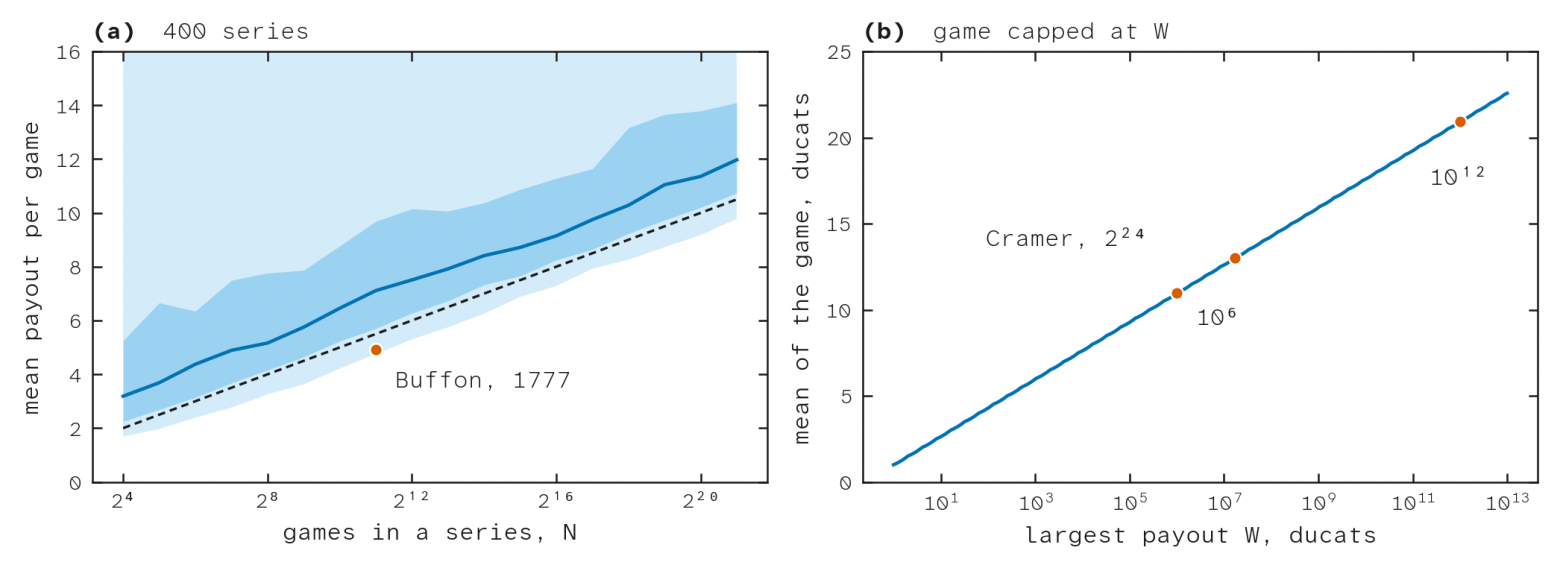 games, 400 simulated series: median, 25–75% and 5–95% of series. The dashed line shows Feller’s law
 , the dot shows Buffon’s experiment. (b) Average of a game whose payout is capped at
 .
So for the St. Petersburg game the first assumption fails. This is the second paradox, the paradox of the series: by common sense the average payout over many games settles down, as in any game with a finite expected value, while by Feller’s calculation it grows without limit. Feller proposed to consider the game fair if the fee per game grows with the length of the series as  . The fair price depends on how many games are played, and Buffon had just one series of 2,048 games, an unlucky one at that.
Cramer’s cap
The second assumption: every payout, however large, enters the average in full. Both the infinite average and the growth of the average payout in a series are caused by rare and very large payouts. Why not simply cut them off?
Cramer proposed exactly this back in 1728. A sum larger than  ducats, he wrote, gives a person no more pleasure than
 itself. Then we may assume that the payout stops at this sum, about 58 tonnes of gold. The average consists of 24 terms of half a ducat and a last term of 1 ducat: a payout of with probability
 .

Let us write the same in general form. If the payout stops growing after  tosses, the game has
 outcomes ( outcomes “heads on toss ” and one more, “no heads”), and its average is
 times the smallest payout. For Cramer,
 .
By Cramer, your price corresponds to the point of the cap: a price of ducats equals the average of the game capped after  tosses. This follows from the same formula,
 . If your price is five ducats, you have, without knowing it, cut the game off after the eighth toss and agreed that its payout never exceeds 256 ducats.
Why Cramer's cap and Feller's law give the same number
Cramer’s cap and Feller’s law are separated by more than two hundred years and connected by one formula. In a series of games the longest game usually lasts about tosses, so the average payout of the series is almost the same as the average of the game capped around that toss. A cap after tosses gives an average of , which coincides with Feller’s fair fee per game in a series of  games. By average payout, the capped game and a long series of the original game are almost indistinguishable.
The cap resolves the first and second paradoxes at once: the capped game has an average, and the law of large numbers applies to it. But where to cap? Cramer took “for the sake of simplicity”, a simplicity worth, one has to admit, 16,777,216 ducats. Why not  or
 does not follow from the argument about pleasure, and the price depends on the choice. The answer to this question will come with the fourth assumption.
Daniel Bernoulli’s utility
The third assumption: every ducat is worth the same to the player, however many ducats he already has. Perhaps the problem lies not in the game but in the person? This answer was proposed by Daniel Bernoulli in the paper “Specimen theoriae novae de mensura sortis” (“Exposition of a New Theory on the Measurement of Risk”). It appeared in 1738, the same year as his “Hydrodynamica”.
The essence of Bernoulli’s proposal is that a payout should be valued not by its amount but by the gain in utility, that is, the value of money to a particular person. Here is what Bernoulli wrote: “The price of the item is dependent only on the thing itself and is equal for everyone; the utility, however, is dependent on the particular circumstances of the person making the estimate.” Bernoulli’s utility grows as the logarithm of wealth. For a person with a thousand ducats, an extra ducat means ten times less than for a person with a hundred.
Admittedly, the idea of valuing money by its utility was expressed before Daniel by Cramer, ten years before the paper appeared. In the same letter to Nicolaus Bernoulli he proposed more than the cap. The gap between the calculation and the ordinary valuation arises, according to Cramer, because “in their theory, mathematicians evaluate money in proportion to its quantity while, in practice, people with common sense evaluate money in proportion to the utility they can obtain from it”. Cramer’s value of money grows as the square root of the sum, Daniel’s as the logarithm of wealth. Daniel learned of the letter from Nicolaus after sending him the paper, and quoted the letter in it: “Indeed I have found his theory so similar to mine that it seems miraculous that we independently reached such close agreement on this sort of subject.” No dispute over priority followed.
The logarithm in perception: the Weber‑Fechner law
A logarithmic valuation was later found in perception as well. By the Weber‑Fechner law (1860), a sensation grows roughly as the logarithm of the stimulus: a person notices an increase in brightness or loudness by its proportion, not by its absolute size. The scales that measure these sensations are logarithmic too: five stellar magnitudes correspond to a hundredfold difference in brightness, and 10 decibels to a tenfold difference in sound power. The German physicist Gustav Fechner (1801–1887), the founder of psychophysics, derived his law, as historians of psychology have shown, from the same principles as Bernoulli.
In Bernoulli’s theory the price of the game depends on how much a person already has. A person without money values the game at 2 ducats, with ten ducats at about 3, with a hundred at about 4, with a thousand at about 6 (figure 3). Strictly speaking, Bernoulli calculates how much a person values a chance he already has. If he has at least ten ducats, he would pay almost as much for such a chance. For the price of the game to reach twenty ducats, Bernoulli’s formula requires wealth of about 290 billion ducats. That is a million tonnes of gold, 4.6 times more than has been mined in all of history. So the twenty ducats named by Nicolaus turn out, by Bernoulli, to be a generous price.
By Bernoulli, your price corresponds to wealth: five ducats is what a person with about 250 ducats would pay for the game, and ten is what a person with about 270 thousand would pay. Remember these two fortunes; they will come up again.
From the same logarithm Bernoulli derived advice that sounds quite modern. The merchant Sempronius keeps goods worth 4,000 ducats at home and ships another 8,000 ducats’ worth by sea, where one ship in ten is lost. If the whole cargo goes on one ship, it is worth 6,751 ducats to Sempronius, not 8,000: the risk of losing everything lowers the value of the cargo to the merchant. If the cargo is split between two ships, it is worth 7,033 ducats. The more ships, the higher the value of the cargo to the merchant, but it never rises above 7,200 ducats, the average. The same advice, Bernoulli adds, applies to those who invest their fortune in foreign bills of exchange. Markowitz’s portfolio theory was still two hundred and fourteen years away.
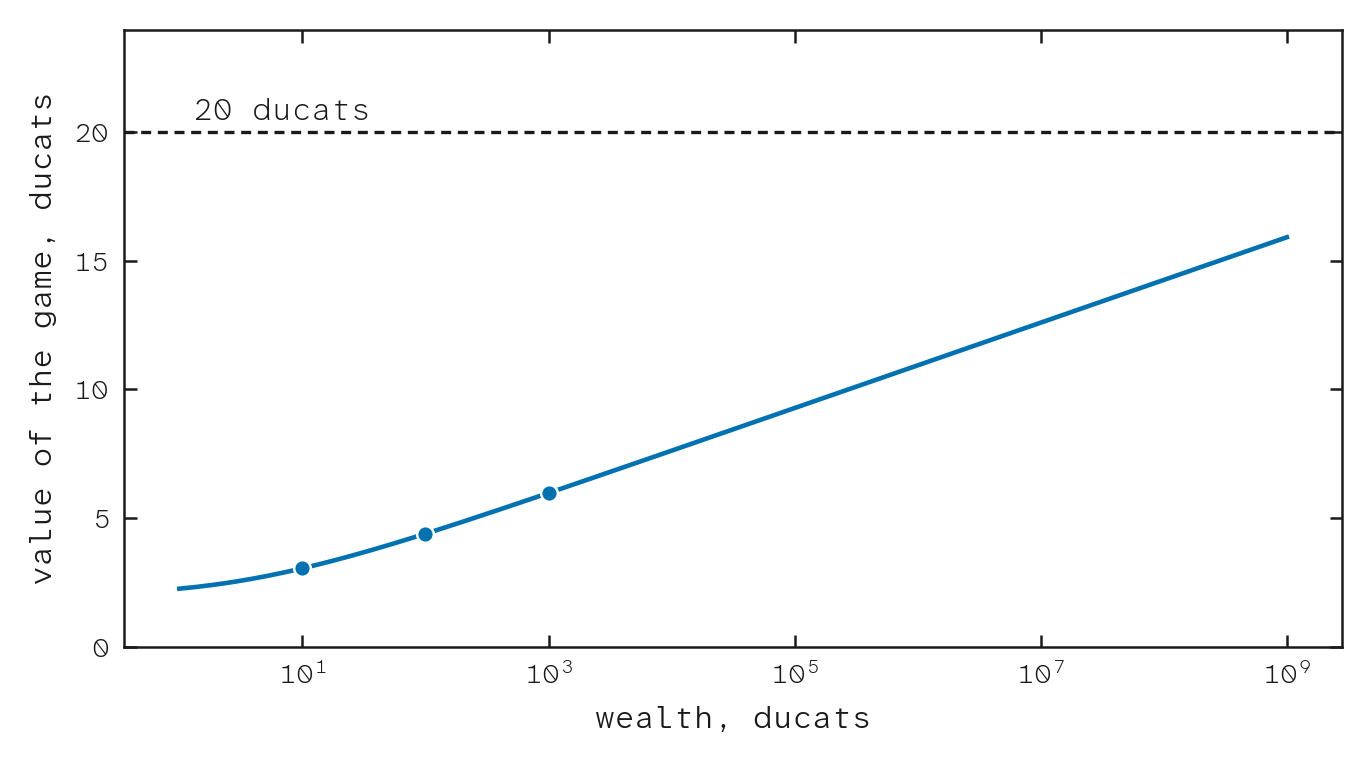
Bernoulli’s answer looks final. But if people are so cautious, why do they buy lottery tickets? A ticket costs more than its average payout, and a person with logarithmic utility will never buy one.
Bernoulli saw the exception himself. A rich prisoner who has 2,000 ducats and needs another 2,000 for his ransom values a prize of 2,000 ducats more highly than a poorer man does. Bernoulli considered such cases exceedingly rare and set them aside. Set them aside, as it turned out, for two hundred and ten years.
The third paradox: insurance and a lottery ticket in the same person
From then on the dispute followed one pattern: a consequence was derived from the theory and compared with what people actually do. Bernoulli’s logarithm implies that nobody buys a lottery ticket that costs more than its average payout. In reality people buy them. So the logarithm does not describe a person completely.
In 1948 the University of Chicago economist Milton Friedman (1912–2006) and the statistician Leonard Savage (1917–1971) returned to the question of lottery tickets. They were struck by the fact that the same person both insures against losses and plays the lottery, although in both cases he pays more than the average. On the one hand, a person who insures avoids risk. On the other hand, a person who buys a lottery ticket seeks risk. How do the two combine in one person?
Friedman and Savage proposed a utility curve that is concave at low wealth, convex in the middle and concave again at high wealth. Where the curve is concave, each additional ducat is worth less than the previous one, and the person avoids risk. Where it is convex, each additional ducat is worth more, and the person seeks risk: the small price of a lottery ticket hardly changes his life, while a large payout would move him into a richer class of society. So a person whose wealth lies at the start of the convex section can both insure against loss and buy a lottery ticket (figure 4). Bernoulli’s rich prisoner fits this curve well: the ransom changes his position, and a prize of 2,000 ducats is worth more to him than by the logarithm. Friedman received the Nobel Prize in Economics in 1976.
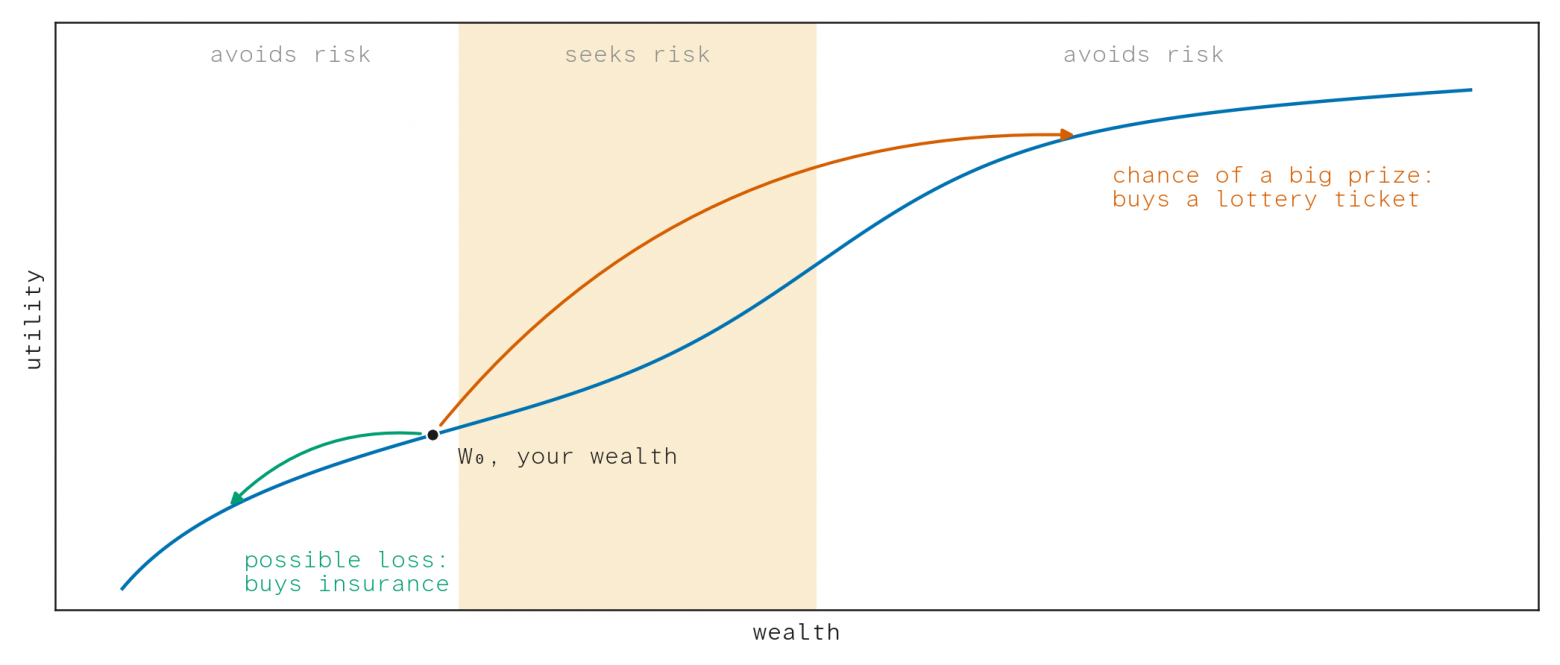
The new curve was tested the same way. Harry Markowitz (1927–2023), the creator of portfolio theory, noticed in 1952 that by this curve people whose wealth lies in the convex section would gladly take large bets at even odds. Almost nobody makes such bets, and once again the consequence was not confirmed. Markowitz proposed measuring utility from a person’s customary wealth. Then a person of any means can combine insurance and a lottery ticket. Markowitz received the Nobel Prize in Economics in 1990 for portfolio theory.
The psychologists Daniel Kahneman (1934–2024) and Amos Tversky (1937–1996) went further in their prospect theory of 1979: the matter lies not only in utility but also in how a person perceives probabilities. People overweight small probabilities. Kahneman and Tversky state directly that the overweighting of small probabilities may explain the attractiveness of both insurance and gambling. In a 1992 paper they summed up the observations as four patterns of attitude to risk:
probability | gain | loss |
|---|---|---|
high | the person avoids risk: takes a sure amount below the average | the person seeks risk: prefers a chance of losing nothing to a sure loss |
low | the person seeks risk: buys a lottery ticket | the person avoids risk: buys insurance |
The psychologist Kahneman received the Nobel Prize in Economics in 2002. Tversky had died by then, and the prize is not awarded posthumously.
Over two and a half centuries the question “what is a coin game worth” turned into the question “how does a person value risk”, and there is still no single answer to it. This is the third paradox, the paradox of insurance and the lottery: by Bernoulli’s logarithm a person who insures will not buy a lottery ticket that costs more than its average payout, while in reality the same person both insures and buys lottery tickets.
The fourth paradox: a bank with nothing to pay
The fourth assumption: Peter will pay any amount. So far the whole dispute has been about Paul, who pays to play. But who will be Peter?
To run the game, someone has to promise any payout, however many tosses it takes. If the bank has finite capital , the payout cannot exceed it, and the average of the game drops to about  (figure 2 b):
bank capital | in gold | average of the game, about |
|---|---|---|
1,000,000 ducats | 3.5 tonnes | 11 ducats |
1,000,000,000 ducats | 3,500 tonnes | 16 ducats |
1,000,000,000,000 ducats | 3.5 million tonnes, 16 times all the gold ever mined | 21 ducats |
By this formula, your price corresponds to the bank’s capital: five ducats to 256 ducats, ten to 262,144. Compare them with the fortunes from the section on Bernoulli: about 250 and about 270 thousand. Two different arguments, about utility and about the bank’s cash, give almost the same numbers, because in both arguments the price of the game grows roughly as half the binary logarithm: of the person’s wealth or of the bank’s capital. A person with logarithmic utility values the game almost as if Peter had exactly as much money as the person does.
The American mathematician Lloyd Shapley (1923–2016), one of the creators of game theory, looked at the argument about the bank’s cash from another side in 1977. By Shapley, the infinite price arises only if the player trusts the bank’s promise, and a reasonable person will not trust such a promise. That is why Shapley titled his paper as a question: “The St. Petersburg Paradox: A Con Game?” Shapley received the Nobel Prize in Economics in 2012, though not for this paper.
Paul would have to trust more than Peter’s cash. In Bernoulli’s version Peter tosses the coin himself, and Paul has to trust his tosses as well.
So for two hundred and sixty years people argued about the price of a game that nobody could honestly run in its original form. This is the fourth paradox, the paradox of the bank. By calculation the game is worth an infinite amount if Peter’s cash is unlimited, while in reality nobody can run it: every bank is finite, and a promise of an unlimited payout cannot be trusted. Here is also the answer to Cramer’s question of where to cap: the payout is capped by the bank’s capital, and the average of the game depends on it. A promise of an unlimited payout is worth exactly as much as a game whose payouts are capped by the cash of whoever makes the promise.
Your price in four theories
your price | by Feller, the average payout in a series of | by Cramer, the game capped after | by Bernoulli, the value for a person with wealth | by the bank’s cash, the game run by a bank with capital |
|---|---|---|---|---|
5 ducats | about 1,000 games | 8 tosses | about 250 ducats | 256 ducats |
10 ducats | about a million games | 18 tosses | about 270,000 ducats | 262,144 ducats |
20 ducats, as for Nicolaus | more than a trillion games | 38 tosses | about 290 billion ducats | about 275 billion ducats |
Thus the price you named in a second corresponds, in four theories, to a series length, a cap point, a fortune and a bank’s capital. A simple coin game raises more questions than it answers. Mark your price in the poll at the end of the article.
Four paradoxes
paradox | by calculation or theory | by experience, common sense or in practice | who formulated it |
|---|---|---|---|
1. The average | the game is worth an infinite amount | a reasonable person values it at less than twenty ducats | Cramer, 1728; Nicolaus Bernoulli |
2. The series | the average payout grows with the series length without limit | the average payout over many games settles down, as in any game with a finite expected value | Buffon, 1777; Feller, 1945 |
3. Insurance and the lottery | by Bernoulli’s logarithm a person who insures will not buy a lottery ticket that costs more than its average payout | the same person both insures and buys lottery tickets | Friedman and Savage, 1948; Markowitz, 1952; Kahneman and Tversky, 1979 and 1992 |
4. The bank | the game is worth an infinite amount if Peter’s cash is unlimited | nobody can run it: every bank is finite, and the promise is not trusted | Shapley, 1977 |
The first assumption is refuted by Feller’s calculation: this is the second paradox. Cramer replaced the second with a cap, which resolves the first two paradoxes but leaves the question of where to cap. Bernoulli replaced the third with the logarithm and explained the low price of the game, but people’s behaviour refuted the logarithm: this is the third paradox. The fourth is refuted by the fact that every bank is finite, and this is the fourth paradox. It also holds the answer to Cramer: cap where the bank’s cash runs out.
The insurer of the merchant Caius
Is there any party at all that can take on someone else’s large risk and still come out ahead? The answer is in the same 1738 paper by Daniel Bernoulli, in the problem about insurance. Here Bernoulli counts in rubles: the merchant is from St. Petersburg.
Caius, a merchant of St. Petersburg, has bought goods in Amsterdam that he could sell in St. Petersburg for 10,000 rubles, and is shipping them by sea. Of a hundred ships, five are usually lost, so the average loss is 500 rubles. Nobody insures the cargo for less than 800 rubles, and Caius considers this price outrageously high. Bernoulli calculates two thresholds:
party | when the deal is reasonable |
|---|---|
merchant | insuring pays if his other wealth is less than 5,043 rubles |
insurer | taking the risk pays if his wealth is more than 14,243 rubles |
Under these conditions, Bernoulli concludes, the insurance benefits everyone in the deal. The merchant pays 300 rubles more than the average loss and gets rid of a risk that is large for him. The insurer is richer, the same risk is small for him, and he receives the 300 rubles above the average for taking the risk on himself. Nobody, not even the richest, should by Bernoulli take this risk for less than the average loss.
The insurer has what Peter lacks. He is rich enough compared with each risk. He takes on many risks, and by the law of large numbers his result is close to the average. He receives a premium above the average, and people pay such a premium both for protection against loss, like Caius, and for a small chance of a large sum, like buyers of lottery tickets.
Can Peter be made into such an insurer? That is, can one build a bank that is rich enough for any permitted payout, caps the game by a rule rather than arbitrarily, does not ask to be taken at its word and receives a premium, like the insurer of Caius? I am developing the PARADOX (PRDX) protocol, which is built exactly this way. The second part is about it: how its design resolves the paradoxes of the average and of the bank, under what condition it resolves the paradox of the series, how it uses the paradox of insurance and the lottery, and what your price means in it.
References
Montmort P. R. de. Essay d’analyse sur les jeux de hazard. Paris, 1713.
Bernoulli J. Ars Conjectandi. Basel, 1713. English translation: The Art of Conjecturing, transl. E. D. Sylla. Johns Hopkins University Press, 2006.
Bernoulli D. Specimen theoriae novae de mensura sortis. Commentarii Academiae Scientiarum Imperialis Petropolitanae, 1738. English translation: Exposition of a New Theory on the Measurement of Risk, transl. L. Sommer. Econometrica, 1954.
Buffon G.‑L. Leclerc de. Essai d’arithmétique morale. Paris, 1777.
Fechner G. T. Elemente der Psychophysik. Leipzig, 1860.
Masin S. C., Zudini V., Antonelli M. Early alternative derivations of Fechner’s law. Journal of the History of the Behavioral Sciences, 2009.
Feller W. Note on the law of large numbers and “fair” games. Annals of Mathematical Statistics, 1945.
Feller W. An Introduction to Probability Theory and Its Applications. Vol. 1. Wiley, 1950.
Friedman M., Savage L. J. The Utility Analysis of Choices Involving Risk. Journal of Political Economy, 1948.
Markowitz H. The Utility of Wealth. Journal of Political Economy, 1952.
Kahneman D., Tversky A. Prospect Theory: An Analysis of Decision under Risk. Econometrica, 1979.
Tversky A., Kahneman D. Advances in Prospect Theory: Cumulative Representation of Uncertainty. Journal of Risk and Uncertainty, 1992.
Shapley L. S. The St. Petersburg Paradox: A Con Game? Journal of Economic Theory, 1977.
World Gold Council. Above‑ground stocks, estimate as of end-2024.