Pull to refresh
8K+

LaTeX *

A set of macros for TeX

-1,6
Rating
Show first
Rating limit
Level of difficulty
Format

Каково ваше мнение о https://proofcheck.org? Это cmd-инструмент, который позволяет проверять TEX-овые доказательства на...

Reading time1 min
Reach and readers14K

Каково ваше мнение о https://proofcheck.org? Это cmd-инструмент, который позволяет проверять TEX-овые доказательства на математическую (!) корректность. Но на русском статей о нём нет, хотя он прост в использовании и по своему принципу функционирования. Прилагаю также proof-of-concept от авторов: https://tug.org/TUGboat/tb30-2/tb95neveln.pdf

Суть в том, что до этого существовало много proof assistant-ов, но эти предложили принципиально новый стандарт парсинга логики, который уложился в скрипт на питоне. В отличие от семейства HOL, основные идеи которого восходят аж к 1970-м. Я считаю, что нужно популяризировать ProofCheck и в рунете.


Читать дальше →

Various things in MetaPost

Reading time8 min
Reach and readers19K
What is the best tool to use for drawing vector pictures? For me and probably for many others, the answer is pretty obvious: Illustrator, or, maybe, Inkscape. At least that's what I thought when I was asked to draw about eight hundred diagrams for a physics textbook. Nothing exceptional, just a bunch of black and white illustrations with spheres, springs, pulleys, lenses and so on. By that time it was already known that the book was going to be made in LaTeX and I was given a number of MS Word documents with embedded images. Some of them were scanned pictures from other books, some were pencil drawings. Picturing days and nights of inkscaping this stuff made me feel dizzy, so soon I found myself fantasizing about a more automated solution. For some reason MetaPost became the focus of these fantasies.


Read more →

Fancy Euclid's “Elements” in TeX

Reading time7 min
Reach and readers29K


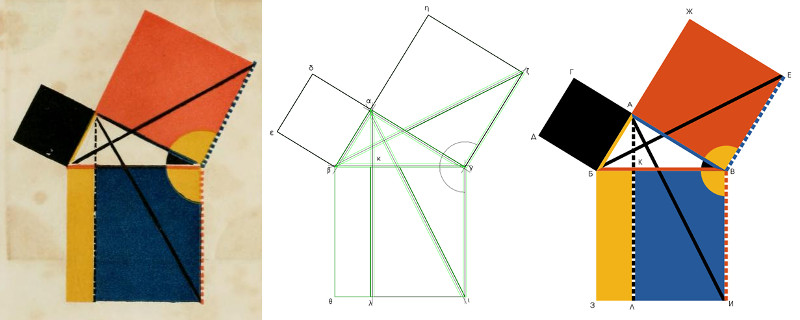
In 2016, I came across Oliver Byrne's “The first six books of the Elements of Euclid.” The main feature of this book is that instead of ordinary letter designations such as “triangle ABC,” it employs inclusions of miniature pictures directly in the text, that is, for example, an image of a triangle. As difficult as it probably was in the XIX century, as easy, with the right tools, it should be to make such a book nowadays. And so I decided to find out by myself whether that's the case.
Read more →