

Приветы! Запилили новый выпуск с задачками, направленными на повышение нейропластичности мозга.

Вдохновлялись собеседованиями в американский Walmart. Ну что, готовы пошевелить извилинами?
Ответы на задачки из прошлого выпуска уже опубликованы. Сверяйтесь.
1. Fill the Jug
2. Geek and Cashier
1. Reverse words in a given string
2. Kadane's Algorithm
3. Ugly Numbers
Вдохновлялись собеседованиями в американский Walmart. Ну что, готовы пошевелить извилинами?
Ответы на задачки из прошлого выпуска уже опубликованы. Сверяйтесь.
Вопросы
1. Fill the Jug
There are two empty jugs each of 4 and 3 liters respectively, without any measuring marks. How many minimum steps are required to have 2 liters of water into the 4 litre jug (the jugs can be filled any number of times with water, and they can be emptied any number of times).
Перевод
Есть два кувшина (изначально пустые) каждый по 4 и 3 литра соответственно, без каких-либо мерных знаков. Сколько минимум шагов требуется для того, чтобы налить 2 литра воды в 4-х литровый кувшин (кувшины можно наполнять водой и опустошать любое количество раз).
2. Geek and Cashier
A Geek asks a cashier to pay Rs 200 for a cool program written by him. He asks the cashier to pay only in the following way:
- Few 1 Rs Notes. Let x.
- Few 2 Rs Notes. Must ten times of 1 Rs Notes, i.e., 10x.
- Rest of the money as 5 Rs Notes(Minimum number Rs 5 notes should be used)
How does the Geek’s Cashier plan to pay?
Перевод
Гик просит кассира заплатить 200 рупий за классную программу, написанную им самим. Он просит кассира заплатить только следующим образом:
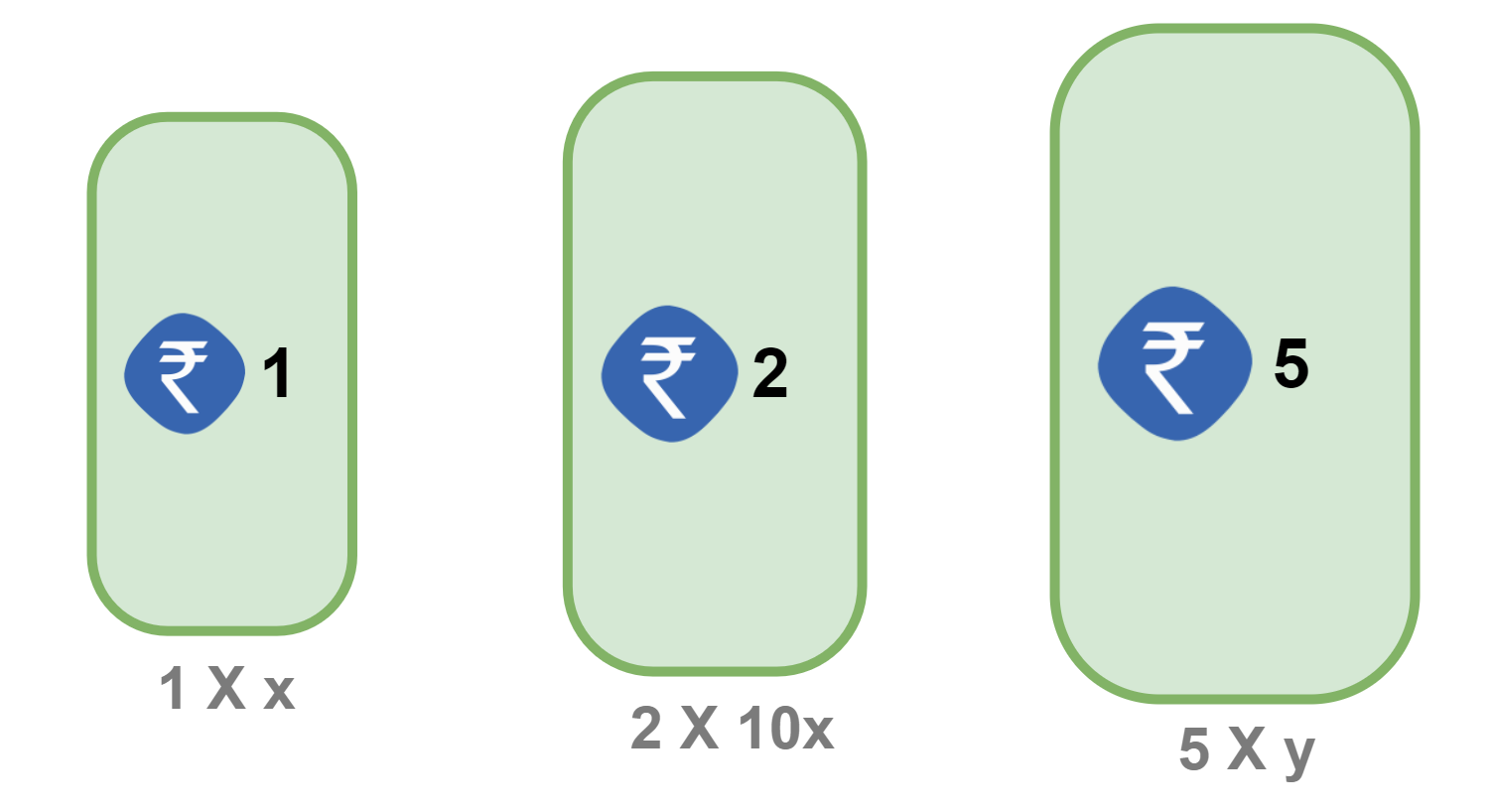
Как собирается расплачиваться кассир?
- Несколько банкнот по 1 Рупии. Пусть X.
- Несколько банкнот по 2 Рупии. Необходимо в десять раз больше, чем банкнот по 1 рупии, то есть 10х.
- Остальные деньги в виде банкнот по 5 рупий(минимальное количество банкнот по 5 рупий должно быть использовано)
Как собирается расплачиваться кассир?
Задачи
1. Reverse words in a given string
Given a String of length S, reverse the whole string without reversing the individual words in it. Words are separated by dots.
Input:
The first line contains T denoting the number of testcases. T testcases follow. Each case contains a string S containing characters.
Output:
For each test case, in a new line, output a single line containing the reversed String.
Constraints:
1 <= T <= 100

1 <= |S| <= 2000
Example:
Input:
2

i.like.this.program.very.much

pqr.mno
Output:
much.very.program.this.like.i

mno.pqr
Перевод
Дана строка длиной S. Переверните всю строку, не меняя местами отдельные слова в ней. Слова разделены точками.
Ввод:
Первая строка содержит T, обозначающее количество тестовых наборов. Каждый тест содержит строку S, содержащую символы.
Вывод:
Для каждого теста в новой строке выведите одну строку, содержащую перевернутую строку.
Ограничения:
Пример:
Ввод:
Вывод:
Ввод:
Первая строка содержит T, обозначающее количество тестовых наборов. Каждый тест содержит строку S, содержащую символы.
Вывод:
Для каждого теста в новой строке выведите одну строку, содержащую перевернутую строку.
Ограничения:
1 <= T <= 100

1 <= |S| <= 2000
Пример:
Ввод:
2

i.like.this.program.very.much

pqr.mno
Вывод:
much.very.program.this.like.i

mno.pqr
2. Kadane's Algorithm
Given an array arr of N integers. Find the contiguous sub-array with maximum sum.
Input:
The first line of input contains an integer T denoting the number of test cases. The description of T test cases follows. The first line of each test case contains a single integer N denoting the size of array. The second line contains N space-separated integers A1, A2, ..., AN denoting the elements of the array.
Output:
Print the maximum sum of the contiguous sub-array in a separate line for each test case.
Constraints:
1 ≤ T ≤ 110

1 ≤ N ≤ 106

-107 ≤ A[i] <= 107
Example:
Input
2

5

1 2 3 -2 5

4

-1 -2 -3 -4
Output
9

-1
Explanation:
Testcase 1: Max subarray sum is 9 of elements (1, 2, 3, -2, 5) which is a contiguous subarray.
Перевод
Дан массив arr из N целых чисел. Найдите смежный суб-массив с максимальной суммой.
Ввод:
Первая строка входных данных содержит целое число T, обозначающее количество тестов. Описание тестов t следующим образом. Первая строка каждого тестового набора содержит одно целое число N, обозначающее размер массива. Вторая строка содержит N целых чисел, разделенных пробелами A1, A2,..., Обозначающий элементы массива.
Вывод:
Выведите максимальную сумму смежного поддерева в отдельной строке для каждого теста.
Ограничения:
Пример:
Ввод
Вывод
Объяснение:
Пример 1: максимальный подмассив — сумма 9 элементов (1, 2, 3, -2, 5) которая представляет собой непрерывный подмассив.
Ввод:
Первая строка входных данных содержит целое число T, обозначающее количество тестов. Описание тестов t следующим образом. Первая строка каждого тестового набора содержит одно целое число N, обозначающее размер массива. Вторая строка содержит N целых чисел, разделенных пробелами A1, A2,..., Обозначающий элементы массива.
Вывод:
Выведите максимальную сумму смежного поддерева в отдельной строке для каждого теста.
Ограничения:
1 ≤ T ≤ 110

1 ≤ N ≤ 106

-107 ≤ A[i] <= 107
Пример:
Ввод
2

5

1 2 3 -2 5

4

-1 -2 -3 -4
Вывод
9

-1
Объяснение:
Пример 1: максимальный подмассив — сумма 9 элементов (1, 2, 3, -2, 5) которая представляет собой непрерывный подмассив.
3. Ugly Numbers
Ugly numbers are numbers whose only prime factors are 2, 3 or 5. The sequence 1, 2, 3, 4, 5, 6, 8, 9, 10, 12, 15, … shows the first 11 ugly numbers. By convention, 1 is included. Write a program to find Nth Ugly Number.
Input:
The first line of input contains an integer T denoting the number of test cases. T testcases follow. For each testcase there is one line of input that contains the number N.
Output:
Print the Nth Ugly Number.
Constraints:
1 ≤ T ≤ 104

1 ≤ N ≤ 104
Example:
Input:
2

10

4
Output:
12

4
Перевод
Уродливые числа — это числа, у которых единственными простыми множителями являются 2, 3 или 5. Последовательность: 1, 2, 3, 4, 5, 6, 8, 9, 10, 12, 15,… показывает первые 11 уродливых чисел. По соглашению, единица включена. Напишите программу, чтобы найти N-е уродливое число.
Ввод:
Первая строка входных данных содержит целое число T, обозначающее количество тестов. Для каждого тестового набора существует одна строка ввода, содержащая число N.
Вывод:
Вывести N-нное по счёту «уродливое» число.
Ограничения:
Пример:
Ввод:
Вывод:
Ввод:
Первая строка входных данных содержит целое число T, обозначающее количество тестов. Для каждого тестового набора существует одна строка ввода, содержащая число N.
Вывод:
Вывести N-нное по счёту «уродливое» число.
Ограничения:
1 ≤ T ≤ 104

1 ≤ N ≤ 104
Пример:
Ввод:
2

10

4
Вывод:
12

4
Ответы
Вопрос 1
Ответ: 6
Объяснение:
Шаг 1: полностью наполните 3-литровый кувшин водой;
Шаг 2: перелейте воду из 3-литрового кувшина в 4-литровый;
Шаг 3: снова наполните 3-литровый кувшин водой полностью;
Шаг 4: налейте воду из 3-литрового кувшина в 4-литровый кувшин, пока 4-литровый кувшин не станет полным;
Шаг 5: вылейте воду из 4-литрового кувшина;
Шаг 6: Теперь у нас осталось 2 литра воды в 3-литровом кувшине. Перелейте воду из 3-литрового кувшина в 4-литровый кувшин, в результате чего в 4-литровом кувшине окажется 2 литра воды.
Объяснение:
Шаг 1: полностью наполните 3-литровый кувшин водой;
Шаг 2: перелейте воду из 3-литрового кувшина в 4-литровый;
Шаг 3: снова наполните 3-литровый кувшин водой полностью;
Шаг 4: налейте воду из 3-литрового кувшина в 4-литровый кувшин, пока 4-литровый кувшин не станет полным;
Шаг 5: вылейте воду из 4-литрового кувшина;
Шаг 6: Теперь у нас осталось 2 литра воды в 3-литровом кувшине. Перелейте воду из 3-литрового кувшина в 4-литровый кувшин, в результате чего в 4-литровом кувшине окажется 2 литра воды.
Вопрос 2
Давайте решим эту задачу поэтапно:
Самая маленькая сумма из 1 рупии и 2 рупий, которую может заплатить кассир, составляет 21 (1 банкнота размером в 1 рупию + 10 банкнот в 2 рупии). Таким образом, кассир должен платить кратно 21, чтобы удовлетворить первые два условия, а также сумма не должна превышать общую сумму в 200 рупий.
Кратные 21:
Из этого числа только 105 кратно 5. Поэтому он должен отдать остаток 95 рупий в 5-ти купюрах.

Ответ: кассир должен выдать 5 купюр по одной рупии, 50 купюр по две рупии и 19 купюр по пять рупий.
Самая маленькая сумма из 1 рупии и 2 рупий, которую может заплатить кассир, составляет 21 (1 банкнота размером в 1 рупию + 10 банкнот в 2 рупии). Таким образом, кассир должен платить кратно 21, чтобы удовлетворить первые два условия, а также сумма не должна превышать общую сумму в 200 рупий.
Кратные 21:
21, 42, 63, 84, 105, 126, 147 и 189.Из этого числа только 105 кратно 5. Поэтому он должен отдать остаток 95 рупий в 5-ти купюрах.
Ответ: кассир должен выдать 5 купюр по одной рупии, 50 купюр по две рупии и 19 купюр по пять рупий.
Задача 1
Если вы используете C++, вы можете использовать встроенную функцию токенизации строк 'strtok':
#include <iostream>
#include<bits/stdc++.h>
using namespace std;

int main() {
	//code
	int t;
	cin >> t;
	while(t--){
	    string ip;
	    cin >> ip;
	    char s[ip.length()];
	    int i;
	    for(i=0;i<ip.length();i++)
	        s[i] = ip[i];
	    s[i]='\0';
	    char *c;
	    vector<string> a;
	    c = strtok(s,".");
	    while(c!=NULL){
	        a.push_back(c);
	        c = strtok(NULL,".");
	    }
	    for(int i=a.size()-1;i>=0;i--){
            cout << a[i];
            if(i!=0)
                cout << ".";
	    }
	    cout << endl;
	}
	return 0;
}
Задача 2
#include <iostream>
#include <stdlib.h>
using namespace std;

int kadane(int arr[], int size){
    int curMax,gMax;
    curMax=arr[0];
    gMax=arr[0];
    for(int i=1;i<size;i++){
        curMax=max(arr[i],curMax+arr[i]);
        gMax=max(curMax,gMax);
    }
    cout<<gMax<<"\n";
    return 0;
}
int main() {
	int ntc , size, arr[100];
	cin>>ntc;
	while(ntc--){
	    cin>>size;
	    for(int i=0;i<size; i++) cin>>arr[i];
	    kadane(arr,size);
	}
	return 0;
}
Задача 3
import java.util.*;
import java.lang.*;
import java.io.*;
class GFG
 {


     static void Ugly(long a[])
     {
            PriorityQueue<Long> pq= new PriorityQueue<>();
            SortedSet<Long> set= new TreeSet<>();

            long source =1;


            //Here we are using the same technique mentioned in hints
            // Using PriorityQueue to retrieve from all min values
            // Storing in SortedSet to avoid duplicacy
            //Note: to avoid further calculations we are calculating it till max test case value 10001 and just returning the arr index


          while(set.size()!=10001)
            {
                if(!pq.contains(source*2))
                    pq.add(source*2);
                if(!pq.contains(source*3))
                    pq.add(source*3);
                if(!pq.contains(source*5))
                    pq.add(source*5);
                set.add(source);

                source=pq.remove();
            }

            int i=0;
            for(long l:set)
            {
                a[i]=l;
                i++;
            }
        }


	public static void main (String[] args)throws IOException
	 {

	     BufferedReader br = new BufferedReader(new InputStreamReader(System.in));
        int t=Integer.parseInt(br.readLine().trim());

        long[] arr= new long[10001];
        Ugly(arr);// to Store ugly no. in an array

        for(int count =0;count<t;count++)
        {
            int num=Integer.parseInt(br.readLine().trim());

         System.out.println(arr[num-1]);
        }

	}

 }

