
Хабр Курсы для всех
РЕКЛАМА
Практикум, Хекслет, SkyPro, авторские курсы — собрали всех и попросили скидки. Осталось выбрать!


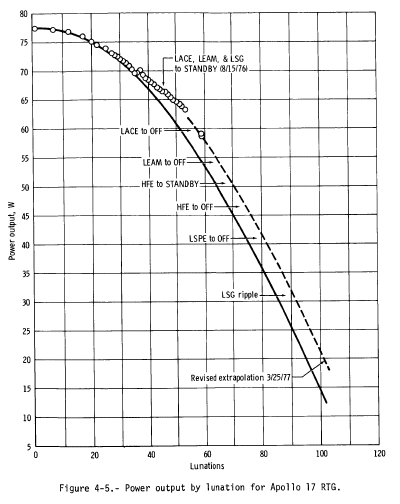
The ALSEP system and instruments were controlled by commands from Earth. The stations ran from deployment until they were turned off on 30 September 1977 due primarily to budgetary considerations. Additionally, by 1977 the power packs could not run both the transmitter and any other instrument, and the ALSEP control room was needed for the attempt to reactivate Skylab.
When funding for the technical and scientific support ran out, all five ALSEP stations were officially shut down on September 30 1977, after more than 153,000 commands were transmitted to them, and more than one trillion bits of science data were received on Earth. Although the experiments were turned off, the transmitters continued to send carrier signals which were used by various institutions, including the Jet Propulsion Laboratory, for geodetic and astrometric studies, and spacecraft navigation.…
The ALSEP program cost NASA an estimated $US200 million, including the design and development of the stations and experiments, support engineering work in Houston, and the analysis of the data by dozens of University laboratories around the world. It cost NASA $US2 million a year to operate.
The NASA Jet Propulsion Laboratory (JPL) needed the ALSEP transmitters for its very long base interferometer (VLBI) experiments and requested that the transmitters be left «on» after the termination of ALSEP operation in 1977.

Multiple layers of protective material protect and contain the fuel and reduce the chance of a release of the plutonium dioxide. The plutonium dioxide pellets are first clad in iridium, a strong, ductile, corrosion-resistant metal with melting point greater than 4820 degrees Fahrenheit (2660 degrees Celsius).


РИТЭГ: прозаичные тепло и электричество для космических аппаратов