

Free VPNs.
In the last few years, internet traffic filtering using TSPU has intensified in the Russian Federation. Hundreds of websites and internet services have been blacklisted and blocked. They can only be accessed via a VPN. However, the most popular VPNs have also been blocked.
The restrictions can be bypassed through a channel on your own foreign server by buying the cheapest hosting there for a couple of dollars or a ready-made VPS with a VPN installed (such ads can be found on Avito). If you don't have your own server, the only option is to use third-party VPN services that have not yet been blocked. The best free VPNs among the survivors are listed below.
Note. Habr will likely block this article for users from the Russian Federation in compliance with Roskomnadzor's ban on information about circumventing blocks, so it's best to save it immediately after publication or subscribe to updates on Telegram.
Blocking VPNs by Signatures
Packet-level internet traffic filtering (DPI) is carried out by TSPU (Technical Means for Countering Threats) devices, which are "black boxes" from RKN, installed at 100% of internet providers. RKN remotely manages them and updates their settings, while providers have no control over the TSPU or any way to influence their operation.
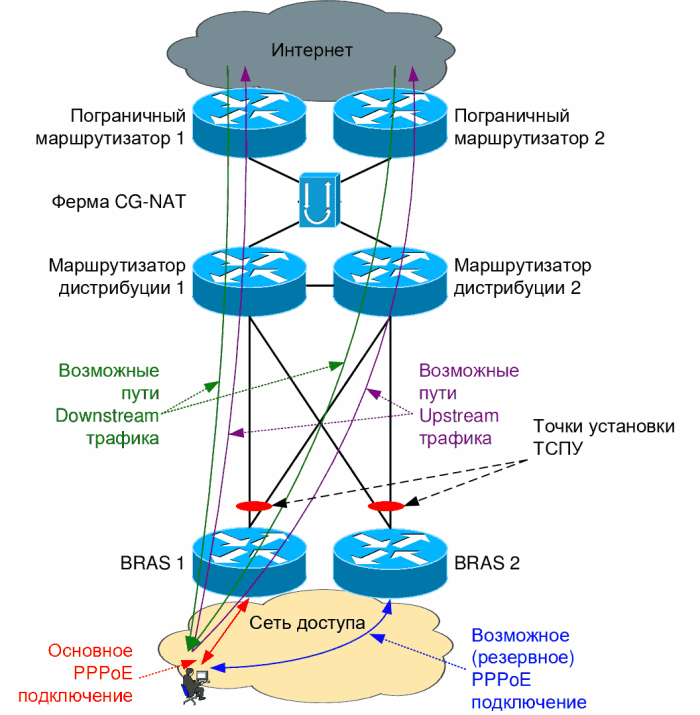
The TSPU equipment, which telecom operators place in separate racks at their sites, is shown in red
The supply and implementation of DPI systems is handled by the company "Data - Processing and Automation Center" (DCOA), which is owned by former officials. The software was developed by RDP.ru.

TSPU and its components, source. The equipment suppliers are "Signaltek," "Yadro," and structures of "Rostelecom"
In the future, RKN plans to upgrade the TSPU to more effectively combat VPNs and generate even more money from equipment supply: "The development of the automated security system (ASBI, the official name of the RKN resource blocking system — author's note) will increase the throughput of TSPU installed at communication nodes to 725.6 Tbit/s and increase the effectiveness of restricting access to VPN blocking circumvention tools to 96%," states the description of measures for the federal project "Data Economy and Digital Transformation of the State."
The details of TSPU's operation are closed to the public. According to some experts, since 2023, the TSPU has been detecting and blocking the signatures of several VPN protocols (OpenVPN, IKEv2, WireGuard), although there are dozens of other protocols and services that the TSPU cannot yet track.
Other experts believe that VPNs are blocked not by protocol, but by the IP addresses of the services. It is said that after the January outage, the TSPU started allowing pure WireGuard, at least.
Users as RKN Agents
In the future, RKN also plans to use more cunning blocking methods, where information about the VPNs being used will be collected from the devices of users who use these services. To this end, a draft order has been presented "On the approval of the procedure, terms, composition, and format for the provision by a communication operator to the federal executive body exercising control and supervision functions in the sphere of mass media, mass communications, information technologies, and communications, of information allowing the identification of communication means and user equipment (terminal equipment) in the information and telecommunication network 'Internet' on the territory of the Russian Federation, the territory of a subject of the Russian Federation, or part of the territory of a subject of the Russian Federation."
In short, RKN will receive information about internet users who visit websites blocked in Russia. Their traffic will make it clear which other VPN services need to be blocked. That is, the users themselves will become "agents" of RKN without their knowledge.
Ban on Information
Since March 1, 2024, an order has been in effect that gives Roskomnadzor the right to block resources that illegally disseminate information about circumventing blocks. For this reason, Habr cannot publish this and other articles about VPNs in the Russian Federation.
According to the new criteria, even scientific and technical information describing the methods of creating and operating VPN services is banned. Access to such information must be restricted.
List of VPNs Blocked in the Russian Federation

The law banning anonymizers and VPN services that do not block access to prohibited sites within three days of receiving a corresponding demand has been in effect since November 2017. RKN carried out the first blocking of VPN services in June 2021 (more than ten services). By March 2022, about 20 VPN services had already been blocked. The list of blocked services included ProtonVPN, NordVPN, Hola!VPN, and others. At the end of 2022, the popular VPN service Surfshark ceased operations. RKN then continued its work, and in 2024, a massive blocking of hundreds of VPN services occurred, and the agency continues to add new TSPU rules to this day.
Currently, about two hundred VPN services are blocked in the Russian Federation, including the following:
- ProtonVPN
- NordVPN
- Hola!VPN
- AdGuard VPN
- AntiZapret
- Psiphon
- Lantern
- RedShield
- TurboVPN
- VPN Proxy Master
- Surfshark
- PureVPN
- ExpressVPN
- IPVanish VPN
- KeepSolid VPN Unlimited
- Speedify VPN
- Betternet
- X-VPN
- Cloudflare WARP
- Tachyon VPN
- PrivateTunnel
- and others.
However, some of the blocked VPNs can still be launched using workarounds, for example, Cloudflare WARP and AdGuard VPN.
All lists of sites, domains, and IP addresses for which decisions have been made to restrict access in Russia are recorded in the registry of prohibited sites.
At the end of May 2022, three main VPN protocols—IPSec, L2TP, and IKEv2—were blocked in some regions of the Russian Federation. As mentioned above, there are now reasons to believe that some VPN protocols are also being blocked by their signatures.
The Best Free VPNs
According to experts, the most resilient VPN services are those that have the ability to use obfuscators and additional transports.
Among the VPNs and other censorship circumvention tools that continue to work in the Russian Federation, the following can be mentioned:
- Tor Browser with onion routing technology, numerous bridges, and traffic obfuscation, there is a version for Android, for Linux, and macOS.

Although RKN tries to block Tor traffic using DPI, it has pluggable transports to bypass blocks. The browser currently supports four pluggable transports:
- obfs4 makes Tor traffic look random and also prevents censors from finding bridges by scanning the internet. obfs4 bridges are less likely to be blocked than their predecessors, obfs3 bridges.
- The meek transport makes it look like you are browsing a major website instead of using Tor. The meek-azure extension makes it look like you are using a Microsoft website.
- Snowflake routes your connection through proxies run by volunteers, making it look like you are making a video call rather than using Tor.
- WebTunnel masks your connection to Tor so that it looks like you are accessing a website via HTTPS.
- obfs4 makes Tor traffic look random and also prevents censors from finding bridges by scanning the internet. obfs4 bridges are less likely to be blocked than their predecessors, obfs3 bridges.
- Opera browser, whose version with VPN is available when accessing from non-Russian IP addresses (in 2021, Opera disabled the VPN function in its browsers within Russia, but this restriction could be bypassed from the very beginning). There is a version for Android.

The VPN is enabled as follows:
- Go to Settings.
- Open the Features section in the sidebar. Alternatively, you can simply type
opera://settings/vpnin the address bar.
- To the left of the VPN line, check the Enable VPN box.

This automatically activates the VPN, and a blue VPN icon appears in the combined address and search bar. Clicking the icon displays a toggle switch, information about the amount of data transferred, the virtual location, and the virtual IP address.

Currently, Opera VPN does not seem to be blocked in the Russian Federation, although this needs to be further verified with different providers.
- Go to Settings.
- Amnezia, there is a version for Android and for iOS. They also have a blog on Habr. You can ask the developers questions in the comments.
- ProtonVPN via Amnezia or via a special config.
- Cloudflare WARP, there is an official app for Android, as well as a modified client on 4pda.
- Karing proxy with obfuscation (Windows/Android/iOS).
- NekoRay.
- Subscriptions — a collection of public servers that don't work for very long, from one day to a couple of months. This list can be imported into NekoRay.

- Exclave (for Android), a fork of SagerNet, a universal proxy toolset for censorship circumvention on Android.
- Hiddify: official clients in the Play Market and AppStore, there is also a client for Windows.
- pluggable transport Geneva (Linux only) — an experimental AI-based circumvention tool. Real-time traffic analysis with corresponding changes in working patterns, see the scientific paper describing the engine and the documentation.
- ProstoVPN.AntiZapret, there is a container for installation on your own server. A similar service for Ukraine: Zaborona.help
In addition to the above, some other VPNs (mostly paid) continue to operate in the Russian Federation today, although they may be unstable.
Unfortunately, the situation with VPNs in the Russian Federation continues to worsen. In the most negative scenario, one can imagine the introduction of administrative and even criminal penalties for using a VPN. Let's hope it doesn't come to that. As far as we know, even in China, using a VPN is not a criminal offense, only providing such services is.
The issue of introducing liability for using VPNs in the Russian Federation has been raised repeatedly. For example, in the summer of 2022, Maria Butina, a deputy from the "United Russia" party, proposed imprisoning the parents of children who use VPNs in case YouTube is blocked.
Currently, using a VPN in Russia is absolutely legal.
For detailed information on circumventing blocks, see the ntc.party forums, as well as a separate guide (mirror).