

Now you don't need a separate torrent client to download and watch movies from torrents. Likewise, you don't need a separate client to seed files via the BitTorrent protocol either. A regular browser is enough; Chrome, Firefox, and Opera (desktop and Android) are supported.
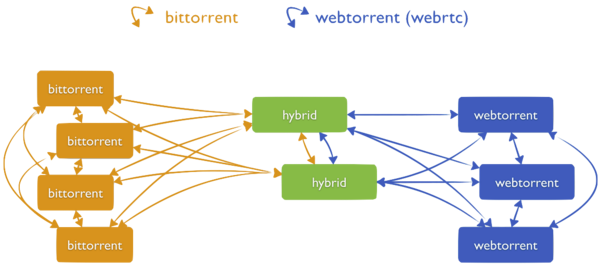
This is all thanks to WebTorrent—a hybrid of BitTorrent and WebRTC. Downloading and seeding happen directly through the website. The built-in player starts showing the movie as soon as a few percent has been downloaded.
To specify files for downloading or seeding, you can use the website https://instant.io/. There, you can specify a magnet link or hash for downloading (for example, like in the blocked torrents on RuTracker).
Alternatively, a standard torrent client interface is implemented in the unofficial project βTorrent.

WebTorrent is the brainchild of Stanford graduate and programmer Feross Aboukhadijeh. He is a fairly well-known developer who has previously come up with several unconventional projects. For example, he demonstrated an exploit of the HTML5 Fullscreen API for a phishing attack. In this case, the victim's browser is forced into full-screen mode, which then renders an interface of the same browser.
Before that, the developer created the peer-to-peer content delivery network PeerCDN, which he sold to Yahoo in 2013.
Feross's latest project could breathe new life into torrents, because many modern users, oversaturated with Netflix-style online video services, are too lazy to download a torrent client and don't want to seed files. WebTorrent does this in the background, imperceptibly to the user, through a regular browser using WebRTC technology.
Perhaps in the future, with the WebTorrent protocol, people will seed not only individual files but entire websites. Such sites, hosted on the computers of thousands of users, can neither be shut down nor blocked.
WebTorrent is the first torrent client that works in the web, requiring no plugins, extensions, or other additional software installation. It is written entirely in JavaScript and uses WebRTC for true peer-to-peer data transfer.
The first raw versions of WebTorrent appeared a couple of years ago, but by now the technology has matured for serious use. Moreover, six months ago, even Netflix itself listed knowledge of WebTorrent as one of the desired requirements for a candidate in a job application. This means that even large companies are considering P2P streaming as a potential business opportunity.
Indeed, such technology can significantly reduce traffic costs and even improve service quality.
"If Netflix used WebTorrent, users would get a better quality video stream during peak hours," says the author. "WebTorrent allows clients of the same internet provider to exchange video fragments with each other without leaving the provider's network. This ensures the best quality even when the channel between the provider and Netflix is completely congested."
Unfortunately, not all browsers support WebRTC yet, but there is reason to believe that the future of the web lies in such decentralized technologies.
TG channel: @alizar_news. My best articles and translations from Habr over 20 years