
This text was written without the use of AI (AI-free)
TABLE OF CONTENTS:
Part 1. Introduction to the topic.
>>> Part 2. Commercial Radio Modems.
Part 4. Assembling and flashing the radio modem.
Continuation of the topic on antennas.
Article 1. Theory. Complex matters in simple words.
Article 2. Simple antennas for Meshtastic
Article 3. Directional antennas for Meshtastic
RADIO MODEM DESIGN
So, you're interested in building your own radio network? You decided to look for like-minded people, and it turns out they exist... But you don't yet know where to get a radio modem or how to make one yourself. In this part, you will find out everything. It's all very simple!
At the beginning of my journey with the Meshtastic project, I conducted a schematic analysis of commercial Meshtastic modems. Fortunately, the information is not secret, and all the schematics are publicly available. Some interesting features emerged – almost all schematics from different manufacturers are typical, with minor differences in non-essential details or non-critical components. This led to the idea that a radio modem could be assembled independently. But, let's take it one step at a time...
All Meshtastic modems consist of the following components:
LoRa module. This is a VHF (160/433MHz) or UHF (868/915MHz) digital single-chip radio transceiver with an amplification and switching circuit on a single independent printed circuit board. In the author's opinion, this is a brilliant solution that saves non-professionals in radio communication from many problems related to designing and manufacturing RF paths. These modules provide radio communication at the physical level via radio waves. Communication frequencies, modulation type, output power, and other radio signal characteristics are set programmatically.
Processor circuit. It is built on a modern, low-power, energy-efficient ESP32 microcontroller, which includes the ability to communicate with the outside world via Wi-Fi and Bluetooth networks. Bluetooth is used for communication between the radio modem and your smartphone. The main feature of the processor circuit is its flexible settings and very low power consumption.
Li-Ion battery control circuit. In the simplest version of the circuit, it's a cheap charge controller-limiter chip. In a more advanced version, it's a special power controller that manages the power consumption of different circuit components, monitors the battery voltage, protects the battery from over-discharge, and controls the charging current.
Graphic OLED LCD screen. Its first and main function is to display the communication code when registering the modem with a smartphone. Depending on the usage scenario, it displays some service information: a short message (numbers/English characters), your own coordinates, and the coordinates with the direction to the nearest visible network subscriber.
Antenna. The component through which radio waves are received and transmitted. (A separate large article will be dedicated to this topic)
This is the minimum set of components for a Meshtastic modem to work. In an extended version of the circuit, the modem includes a GPS module, a page-scrolling button (each network subscriber is displayed on their own page), and processor status LEDs.
Another factor that might influence your decision to engage in this creative endeavor is the project's openness for self-study at the firmware source code level. All Meshtastic project source codes are available on Github. Unfortunately, the author of this article is not a programmer, but university-level knowledge of programming basics and help from several qualified community members were enough to figure out how to configure the radio modem at the hardware level for the components at hand and for my own tasks. The author is confident that the community will have many enthusiasts willing to develop the topic to a more global scale and with new technological solutions. Join us!
OVERVIEW OF EXISTING READY-MADE SOLUTIONS
Before assembling anything, it makes sense to look at the commercial radio modem kits on Aliexpress, assess your own assembly capabilities, and decide whether to buy a radio modem or build one yourself. If you are a busy person, or not a radio amateur at all but are interested in the topic, it's better to buy a ready-made kit and "flash" it. This is the easiest option without the hassle of a soldering iron and unnecessary worries. You buy it, turn it on, and everything works right away! Beautiful! If you are a restless creative seeker and enjoy working with your hands and mind, then in the next part, you will find a description of how and from what to assemble a radio modem yourself.
Initially, the kits were developed for various LoRa applications as starter modules for different developments. They fit very well into the new project. You just need to upload a special firmware, and the kit turns into a Meshtastic radio modem. The firmware is available on the Github of the Meshtastic project's author, is completely free, and can be modified by you if you have C++ knowledge.
Below is a list of ready-made devices from Aliexpress. I am not providing links to them; they can be easily found via Google or by asking in the community.
Kit #1. The most advanced radio modem from TTGO, but without a screen.
LILYGO TTGO T-Beam V1.1 SX1262 LORA 868/915MHZ ESP32 WiFi Wireless Bluetooth Module GPS NEO-M8N IPEX 18650 Battery Holder

Microcontroller: ESP32 - Wifi & Bluetooth
Radio chip: SX1262 - LoRa Transceiver, which currently has the best parameters
Frequency ranges: 433 MHz / 863-870 MHz / 902-928 MHz
Advanced power controller
Sold without a 0.96” OLED screen
Includes a U.FL connector for the LoRa antenna
Full-size antenna included
Buttons included: Power / Reset / Programming
GPS module – NEO-8M (modern, high-sensitivity)
Powered by a standard 18650 Li-Ion battery
Firmware file: firmware-tbeam-1.x.x.bin
A Meshtastic modem for final self-assembly. This is the most modern kit for a Meshtastic modem available today, with an up-to-date NEO-8 GPS module and the most advanced SX1262 radio chip. It is sold without a screen. You need to buy an I2C OLED LCD based on the SSD1306 graphics processor, solder it, and secure it. As practice shows, this is not manageable for all beginners, so think carefully before buying this modem whether you can assemble it without risk of damage. The price is around 2800 rubles. If the price doesn't deter you, this is the best option to start with. Sold in the official LiLYGO store.
Kit #2. An intermediate version of the kit, with a good GPS, but without a screen.
GPS NEO-M8N of LILYGO TTGO T-Beam V1.1 ESP32 LORA 433/868/915/923MHZ WiFi Wireless Bluetooth Module IPEX 18650 Battery Holder

Microcontroller: ESP32 - Wifi & Bluetooth
Radio chip: SX127x - LoRa Transceiver
Frequency ranges: 433 MHz / 863-870 MHz / 902-928 MHz
Advanced power controller
Sold without a 0.96” OLED screen
Includes a U.FL connector for the LoRa antenna
Includes a cheap, shortened antenna
Buttons included: Power / Reset / Programming
GPS module – NEO-8M (modern, high-sensitivity)
Powered by a standard 18650 Li-Ion battery
Firmware file: firmware-tbeam-1.x.x.bin
A Meshtastic modem for final self-assembly. It has a modern NEO-8 GPS module but is sold without an LCD screen. You need to buy an I2C OLED LCD based on the SSD1306 graphics processor, solder it, and secure it. As practice shows, this is not manageable for all beginners, so think carefully before buying this modem whether you can assemble it without risk of damage. The price is around 2500 rubles. Sold in the official LiLYGO store.
Kit #3. A fully assembled radio modem with pre-installed Meshtastic software
LILYGO TTGO Meshtastic T-Beam V1.1 ESP32 433/868/915/923Mhz WiFi Bluetooth ESP32 GPS NEO-6M SMA 18650 Battery Holder With OLED
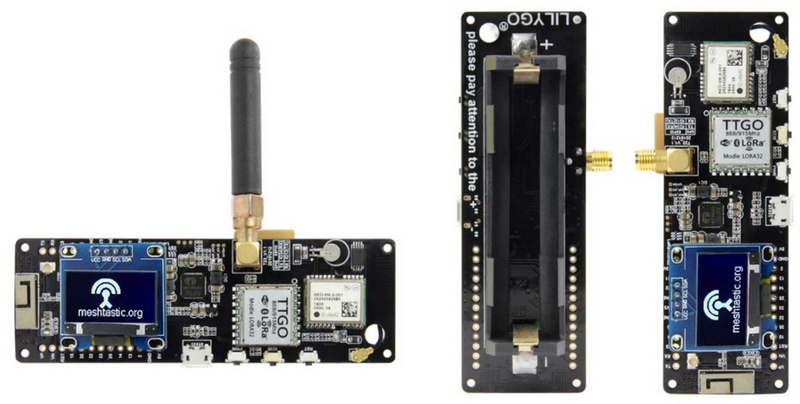
Microcontroller: ESP32 - Wifi & Bluetooth
Radio chip: SX127x - LoRa Transceiver
Frequency ranges: 433 MHz / 863-870 MHz / 902-928 MHz
Advanced power controller
Includes a 0.96” OLED screen
Includes an SMA connector for the LoRa antenna
Includes a cheap, shortened antenna
Buttons included: Power / Reset / Programming
GPS module – NEO-6M (old and cheap)
Powered by a standard 18650 Li-Ion battery
Firmware file: firmware-tbeam-1.x.x.bin
A fully finished and ready-to-use radio modem for the Meshtastic network, in almost maximum configuration... but not quite. It is usually sold with pre-installed software. This modem has an outdated NEO-6 GPS module. If you are just getting into the topic and don't have the ability to solder anything yourself, this is a good option to start with. The price is around 2800 rubles. Sold in the official LiLYGO store.
Kit #4. The minimal viable modem.
TTGO LORA32 V2.0 433/868/915Mhz ESP32 LoRa OLED 0.96 Inch SD Card Display Bluetooth WIFI ESP32 Module With Antenna
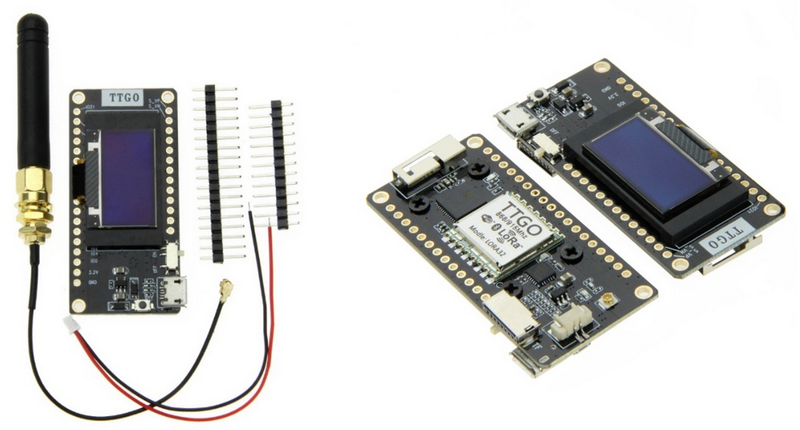
Microcontroller: ESP32 Pico D4 - Wifi & Bluetooth
Radio chip: SX127x - LoRa Transceiver
Frequency ranges: 433 MHz / 863-870 MHz / 902-928 MHz
No power controller, only a charging circuit.
Built-in 0.96” OLED screen
Includes a U.FL or SMA connector for the LoRa antenna (depends on the version)
Includes a cheap, shortened antenna
Buttons included: Reset and a mechanical power switch.
The screen scrolling button is missing; you will have to solder it yourself.
No GPS module, but it's possible to connect an external one.
Possible to connect a Li-Po battery
Firmware file: firmware-tlora-v2-1-1.6-1.x.x.bin
The minimal viable Meshtastic modem for creating a network today. It is built on the energy-efficient, latest-generation ESP-32 Pico-D4 processor. It doesn't have a GPS module, but that's not a problem – coordinates can be pulled from the phone's GPS module. You can modify it with a GPS module yourself. It has had 3 different modifications in the past: V1, V1.3, and V2, each with its own firmware. The price is around 1500 rubles. Sold in the official LiLYGO store.
The author of this article started with this module, and it has proven to be excellent!
Kit #5. The cheapest radio modem. (Not recommended)
Heltec WIFI Lora Kit 32 V2 433MHZ ESP32 LoRa SX1278 esp32 0.96 Inch OLED Display Bluetooth Development Board for Arduino
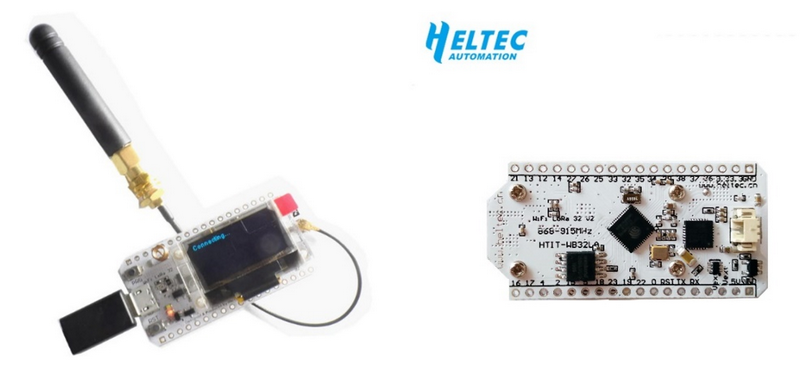
Microcontroller: ESP3212 - Wifi & Bluetooth (Old chip)
Radio chip: SX127x - LoRa Transceiver
Frequency ranges: 433 MHz / 863-870 MHz / 902-928 MHz
No power controller, only a charging circuit.
Built-in 0.96” OLED screen
Includes a U.FL connector for the LoRa antenna
Includes a cheap, shortened antenna
Buttons included: Reset and programming.
The screen scrolling button is missing; you will have to solder it yourself.
Possible to connect a Li-Po battery (There are issues with over-discharge)
Firmware file: firmware-heltec-1.x.x.bin
The cheapest Meshtastic modem. Built on an old and weak processor. The most hyped. The smallest in size, there are projects for interesting cases, but many negative reviews regarding its operation. They have a tendency to suddenly die for no reason. The price is around 1500 rubles. Sold in the official HELTEC store. Not recommended for purchase, unless it's for a nice miniature case. If you have several modems and this one dies, it's not a big loss.
This list does not cover all radio modem kits. There are also finished products based on "RAK modules" of the RAK46xx series with a solar panel controller. However, they are quite rare and the prices for the Russian market are exorbitant, so the author does not include them in the description. If necessary, you can easily find them yourself.
This small set exhausts the selection of ready-made Meshtastic modems. On the official project website, you can find a large comparison table of original Meshtastic modems, their various release modifications, and the few noname clones. Mostly, these are copies of branded LILYGO and HELTEC products.
This concludes the author's introduction to commercial kits for the Meshtastic network. The next part will describe in detail what to build a radio modem from and how to do it yourself.
Part 1. <<<<<<<<<< Part 2. >>>>>>>>>> Part 3 DIY Radio Modems.
Addresses of local Meshtastic communities:
Local Meshtastic Telegram chats, check if your city is here.
Barnaul https://t.me/meshtastic_barnaul
Belaya Kalitva https://t.me/meshkalitva
Belgorod https://t.me/meshtastic_belgorod
Berdsk https://t.me/Meshtastic_Berdsk
Bryansk https://t.me/meshtastic_Bryansk
Veliky Novgorod https://t.me/meshtastic_vnov
Vladivostok https://t.me/meshtastic_vld
Volgograd and Volzhsky https://t.me/meshtastic_vlg
Voronezh https://t.me/meshtastic_vrn
Gelendzhik https://t.me/meshtastic_gel
Dubna https://t.me/meshtastic_dubna
Yekaterinburg https://t.me/meshtastic_ekb
Yoshkar-Ola https://t.me/meshtastic_yoshka
KMV - Caucasian Mineral Waters (Pyatigorsk, Kislovodsk, Yessentuki, Mineralnye Vody, Zheleznovodsk) https://t.me/meshtastic_kmv
Izhevsk https://t.me/meshtastic_izh18
Kazan https://t.me/ham_radio_kazan/19790
Kazakhstan https://t.me/meshtastic_kz
Kaliningrad https://t.me/meshtastic_39
Kaluga https://t.me/meshtastic_kaluga
Kemerovo https://t.me/meshtastic_kmr
Kirov https://t.me/meshtastic_krv43
Konakovo https://t.me/meshtastic_konakovo
Krasnodar https://t.me/Meshtastic_RUS_KRD
Krasnoyarsk https://t.me/meshtastic_krsk
Kropotkin https://t.me/meshtastic_kropotkin
Kurgan https://t.me/meshtastic_kurgan
Kursk https://t.me/meshtastic_kur
Luhansk People's Republic (LPR) https://t.me/meshtastic_lnr
Moscow https://t.me/meshtastic_moscow
Murmansk https://t.me/meshtastic_51
Naberezhnye Chelny https://t.me/meshtastic_chelny
Nizhny Novgorod https://t.me/meshtastic_nnov
Novosibirsk https://t.me/meshtastic_nsk
Obninsk https://t.me/Meshtastic_Obninsk
Orenburg https://t.me/meshtastic_oren
Penza https://t.me/meshtastic_penza
Perm https://t.me/Meshtastic_perm
Petrozavodsk https://t.me/meshtastic_petrozavodsk
Pushkino https://t.me/meshtastic_pushkino
Rostov-on-Don https://t.me/meshtastic_rnd
Ryazan https://t.me/meshtastic_rzn
Rybinsk https://t.me/meshtastic_ryb
Saint Petersburg https://t.me/meshtastic_spb
Samara https://t.me/meshtastic_63
Saratov https://t.me/meshtastic64
Serpukhov https://t.me/Meshtastic_BigSERP
Sevastopol https://t.me/meshtastic_sevastopol
Smolensk https://t.me/meshtastic_sml
Sochi https://t.me/meshtastic_sochi
Stavropol https://t.me/meshtastic_stv
Surgut https://t.me/meshtastic_surgut
Syktyvkar https://t.me/meshtastic_syktyvkar
Tambov https://t.me/meshtastic_TMB
Tolyatti https://t.me/meshtastic_tlt
Tomsk https://t.me/meshtastic_tom
Tula https://t.me/meshtastic_tula
Tyumen https://t.me/meshtastic_tym
Ulyanovsk https://t.me/meshtastic_ulsk
Ufa https://t.me/meshtastic_ufa
Feodosia https://t.me/meshtastic_feo
Khanty-Mansiysk https://t.me/meshtastic_hm
Chelyabinsk https://t.me/meshtastic_chel
Chekhov https://t.me/Meshtastic_Chekhov
Chuvashia https://t.me/meshtastic_chuv
Yaroslavl https://t.me/meshtastic_yar