Pull to refresh
128K+

Data visualization *

We enclose the data in a beautiful shell

34,71
Rating
Show first
Rating limit
Level of difficulty

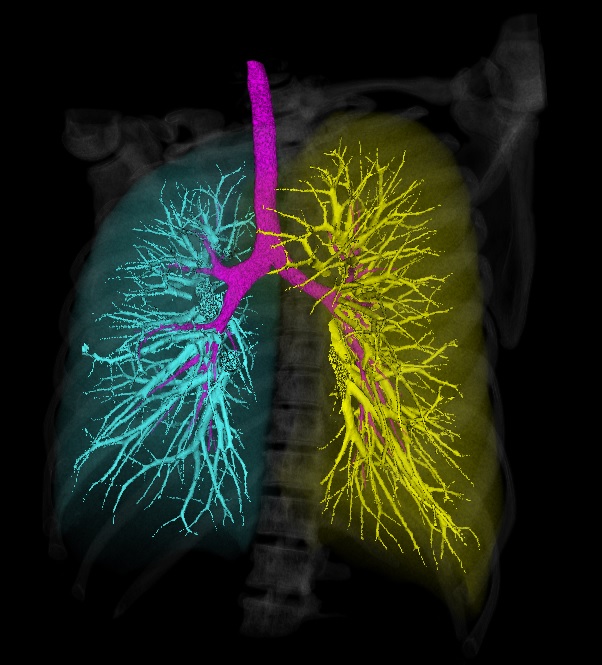
Automatic respiratory organ segmentation

Reading time8 min
Reach and readers2.5K

Manual lung segmentation takes about 10 minutes and it requires a certain skill to get the same high-quality result as with automatic segmentation. Automatic segmentation takes about 15 seconds.


I assumed that without a neural network it would be possible to get an accuracy of no more than 70%. I also assumed, that morphological operations are only the preparation of an image for more complex algorithms. But as a result of processing of those, although few, 40 samples of tomographic data on hand, the algorithm segmented the lungs without errors. Moreover, after testing in the first five cases, the algorithm didn’t change significantly and correctly worked on the other 35 studies without changing the settings.


Also, neural networks have a disadvantage — for their training we need hundreds of training samples of lungs, which need to be marked up manually.

Read more →

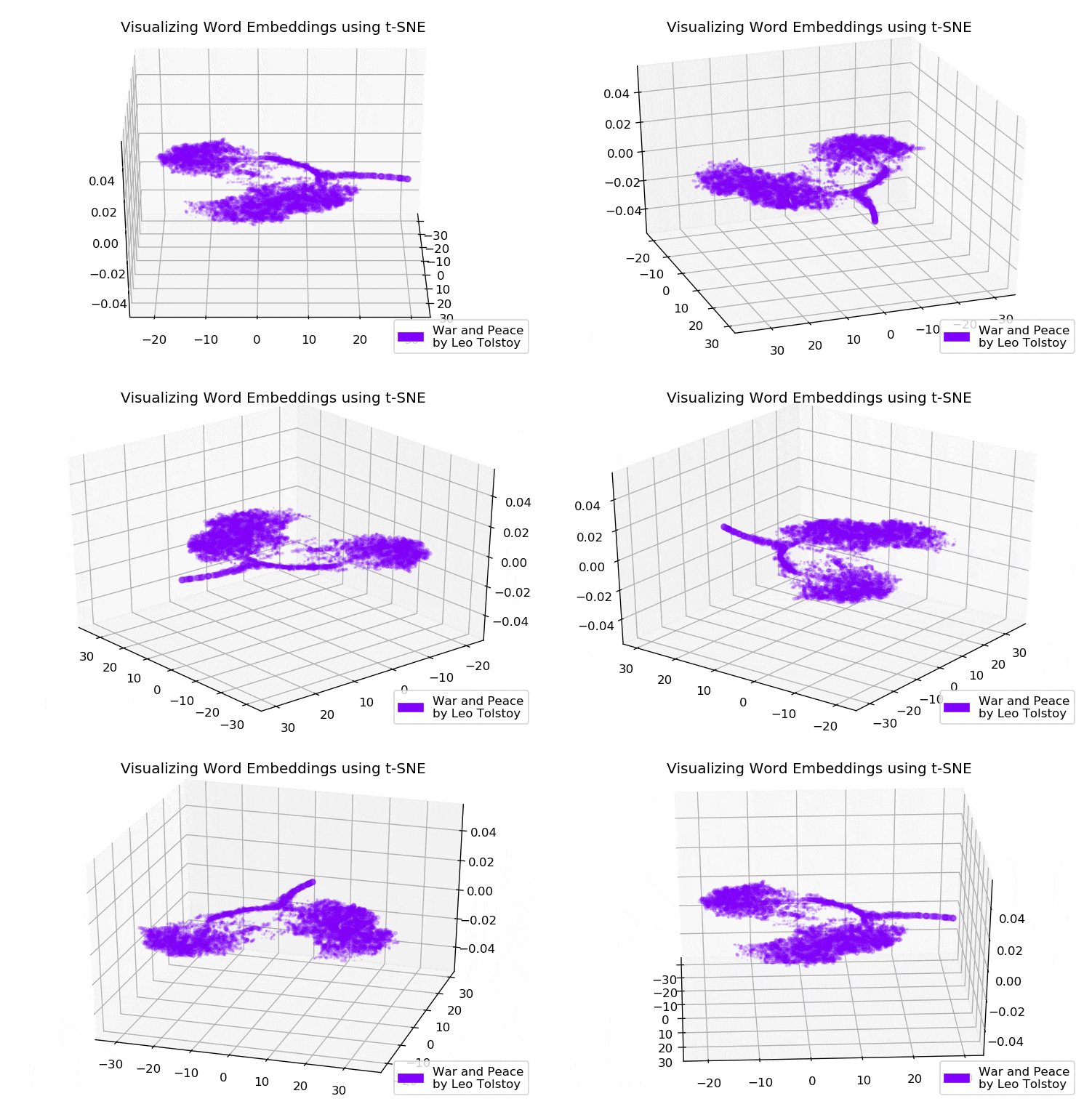
Google News and Leo Tolstoy: visualizing Word2Vec word embeddings using t-SNE

Reading time7 min
Reach and readers15K

Everyone uniquely perceives texts, regardless of whether this person reads news on the Internet or world-known classic novels. This also applies to a variety of algorithms and machine learning techniques, which understand texts in a more mathematical way, namely, using high-dimensional vector space.

This article is devoted to visualizing high-dimensional Word2Vec word embeddings using t-SNE. The visualization can be useful to understand how Word2Vec works and how to interpret relations between vectors captured from your texts before using them in neural networks or other machine learning algorithms. As training data, we will use articles from Google News and classical literary works by Leo Tolstoy, the Russian writer who is regarded as one of the greatest authors of all time.

We go through the brief overview of t-SNE algorithm, then move to word embeddings calculation using Word2Vec, and finally, proceed to word vectors visualization with t-SNE in 2D and 3D space. We will write our scripts in Python using Jupyter Notebook.

Read more →
2