
Hello, Habr!
In this article, I will share my experience of learning English and the things that worked and didn't work for me personally. The process of learning a language is very individual, and you can never claim that one method/scheme is the right one (although some articles on Habr directly say: this method is right, and that one is not).
Let's start with the background and reasons
I am a mechanical engineer (my specialty is mechanical seals for rotating shafts). I started working in my field right after my bachelor's degree, while also finishing my master's. As soon as I started working, I tried to absorb as much theoretical knowledge in my specialty from academic sources as possible. I quickly realized that the last serious book in my specialty in Russian was written in 1978. And after more than 40 years, the technology has changed significantly, but there was no description of it in Russian. However, I found people on Reddit working in America in my same industry. They recommended a lot of great literature to me. Of course, it was all in English and had no Russian translation.
I started my language learning journey in January 2022 from a near-zero level. In all my schools, English language teaching was not at the highest level, and at university, it was enough to memorize 30 sentences to get a decent grade on the exam.
Of course, before starting, I read many articles on Habr about how people learn languages. Some of them were amazing in their speed of mastering the material (something like from zero to fluent in 4 months). But one thing was constant – everyone had some kind of language learning plan.
Defining goals
First of all, I decided that I needed to determine what level of language proficiency I wanted to achieve (I deliberately stopped using the term 'learn the language' because, in my opinion, it sounds incorrect. You are either a native speaker or you have a certain level of proficiency). I looked at job vacancies from foreign employers and saw what level of English proficiency the international giants in my industry wanted for my specialty. Almost everywhere it was just 'excellent spoken and written English,' but eventually I found that for a mid-level engineer position, a B2 level according to the CEFR (Common European Framework of Reference for Languages) would be quite sufficient.
So, the goal was clear. Next, I needed to figure out who would confirm that I had reached the B2 level. This is where international exams like TOEFL iBT and the 'Academic English Exam' come in. The differences between these exams are a topic for a separate article. Initially, I started preparing for the TOEFL iBT, but after a few months, I switched to preparing for the 'Academic English Exam'. You can find information on the internet about how the score on the 'Academic English Exam' correlates with CEFR levels.
Learning Plan
Next, I needed a learning plan. I read many different schemes, but I didn't like any of them. I decided to try everything a little bit on my own and see what worked for me and what didn't. My entire learning process can be divided into 2 major stages:
Improving general English proficiency (reading skills and listening comprehension of native speakers)
Direct preparation for the exam in 4 sections: reading, listening, writing, and speaking.
Stage one: reading and listening
I decided to start with the Oxford Bookworms Library series. It's a professionally curated library for English learners, which includes adapted versions of classic and modern literature, as well as real-life stories. The books are divided into 6 difficulty levels. At the initial stage, I determined my level was level 3. The entire series of these books can be easily found on the internet. I read about 30 level 3 books, about 15 level 4 books, and 5-6 books each for levels 5 and 6.
The reading method was extremely simple:
See an unfamiliar word – look it up in the dictionaryI type it into Yandex Translate, then write it down to learn after finishing the book. At first, I used Yandex Translate, then I started using a dictionary where the word's definition is given in English. This, of course, increased the time spent, but it was tolerable for the Oxford Bookworms Library books.
About memorizing words with flashcards.
While reading the Oxford Bookworms Library books, I wrote down unfamiliar words and memorized them after finishing. Sometimes there were too many words, so I set a limit for myself: 20 words per book. I read one book after another, and out of 20 learned (and repeated several times that day) words, after 3 days, I was lucky if 2-3 words remained in my head. I really didn't like that. I had read so much about memorizing words with flashcards that I decided to review all the previous words every day so I wouldn't forget anything. I reached 160 words, and one day I spent 6 hours reviewing and reinforcing them (there was simply no time left for books or podcasts), and I realized it was torture and would lead nowhere. From that day on, I never opened the flashcard app again.
In parallel with reading adapted books, I found this podcast: “Listening time”and listened to 60 episodes with simplified language (the host speaks slower than his usual pace and tries to enunciate words more clearly) using this method:
Listening without a transcript
Listening and reading the transcript
Listening without a transcript
If the podcast was quite difficult, I would listen to it 5-6 times, alternating between reading the transcript and just listening.
By the end of spring 2022, I had finished the Oxford Bookworms Library series and the beginner podcasts. I switched to a podcast where the same host speaks at his normal pace, and I worked with the podcasts using the same method. Plus, I started looking for English-language podcasts (always with a transcript) that were 10-15 minutes long on topics that interested me. The difference in comprehension was significant; I had gotten used to the voice of the 'Listening time' podcast host and understood him much better than the hosts of other English-language podcasts. And if there was more than one person in the podcast, my comprehension got even worse. I started alternating podcasts: one day, a podcast from the host whose voice I was used to, and the next day, some other podcast on a topic I found interesting.
Next, I decided I was definitely ready to read books in the original English. The first thing that came to mind was Tom Sawyer.
It was an absolute shock – I didn't understand a damn thing after reading the first 2 pages. It would have been the right time to admit my mistake and choose another book, but for some reason, I decided I had to read this specific one. The first thing I did was switch to a regular English-to-Russian translator that can translate directly in a PDF (Reverso). I read using the following method:
Read 2-3 pages
Read them again, translating all unfamiliar words
Read them one more time without looking at the dictionary
If anything in a sentence remains unclear, I repeat steps 2 and 3 until I fully understand every sentence.
Even with an English-to-Russian translator, it took me about 3-5 hours to get through 3-4 pages of the book. In total, I spent about 2 months reading just Tom Sawyer, and it was the most painful period of my language learning. But it must be said, the book is amazing, especially if you didn't read it in school. However, even native American English speakers say that the language in Mark Twain's books is perceived differently due to the considerable age of the works.
After struggling through Tom Sawyer, I couldn't think of anything better than to read Huckleberry Finn. But I changed my reading method. Now I would reread a chapter only once if I understood the general action, and I only looked up the translation of words necessary to understand the main action (mostly verbs and nouns). I mentally categorized adjectives as either positive or negative descriptions. The process went much faster; I spent about a month reading Huckleberry Finn.
And then I finally made the right decision and decided to reread books in English that I had already read in Russian: Orwell's '1984' and Huxley's 'Brave New World'. I read them using the same method as with Huckleberry Finn. I always underlined words I didn't know, but more so I could find them faster when I had to type them into a translator while rereading the chapter (starting with '1984', I read physical copies because I prefer them). And of course, if I understood the general meaning of a sentence, I didn't even try to translate the unknown words in it. In parallel with starting '1984', I googled what is considered classic American literature and ordered about 20 books from Amazon in the US.
I can't say that my vocabulary drastically increased right after reading 4 books in the original, but I became much faster at extracting meaning from paragraphs and sentences, and having 50% unknown words in a sentence no longer stumped my brain and made it refuse to think.
Then I gradually increased my reading speed to 1 book every 2 weeks. Here is my list of books read in the original English at the time I took the 'International English Language Test (Academic Module)' (+/- in chronological order):
“The Adventures of Tom Sawyer” Mark Twain
“Huckleberry Finn” Mark Twain
“1984” George Orwell
“Brave New World” Aldous Huxley
“Serious Reflections During the Life and Surprising Adventures of Robinson Crusoe” Daniel Defoe
“The Lost World” Sir Arthur Conan Doyle
“Because Internet” Gretchen McCulloch
“Ella Minnow Pea” Mark Dunn
“The Great Gatsby” F. Scott Fitzgerald
“Fahrenheit 451” Ray Bradbury
“The Old Man and the Sea” Ernest Hemingway
“The Catcher in the Rye” J. D. Salinger
“Animal farm” George Orwell
“To Kill a Mockingbird” Harper Lee
“The Age of Innocence” Edith Wharton
“Asya” Ivan Turgenev
“For Whom the Bell Tolls” Ernest Hemingway
My recommendation for those who want to start reading books in the original:
Choose a book you have already read in Russian.
If you want to start something new – start with “The Catcher in the Rye” by J. D. Salinger. So far, it's the easiest book I've read in English in terms of vocabulary.
From the beginning of June 2022, I found an English-speaking teacher on italki and started having lessons with him once a week. Since I had basically never spoken more than 2-3 monosyllabic sentences in English before, the lessons were difficult at first, but after 2-3 months, I learned to express my thoughts somehow, albeit with a modest vocabulary.
Regarding the choice of a teacher.
I think it's important to choose a teacher who doesn't know your native language to avoid the temptation of asking a couple of 'clarifying questions' in your native tongue.
I continued at this pace (1 lesson with a teacher per week, 1 podcast per day (using the same method of alternating listening with and without a transcript), and regular book reading) from the beginning of summer 2022 right up to the next year, 2023. Of course, I combined all this with a 9-to-5 job and the daily routine of an adult.
About studying grammar.
At first, I made some attempts to solve specialized English grammar exercises. I even got out my green Golitsyn textbook and did a small number of exercises, but the English sentences taken out of context seemed boring and a waste of time. Besides, try asking a native English speaker sometime in which cases they use the present perfect simple in everyday speech. If they don't have a linguistic education or extensive experience teaching the language, they will likely freeze for a long time and give a vague answer that is very far from the definition in the Cambridge Dictionary Grammar, even though they use it quite often. In the end, I only occasionally latched onto some grammatical structure in a book and opened the Cambridge Dictionary Grammar in an attempt to figure out what kind of structure it was. I had mixed success, but I didn't focus on it.
The year 2023 arrived. I understood that I could read English pretty well, my listening comprehension was a bit worse, and my speaking was even worse. But I had no idea how to express my thoughts in writing. Since I was planning to take an exam that required writing a detailed essay in English, it was time for me to do something about it. At the beginning of 2023, I was still sure I wanted to take the TOEFL (mostly because I only listened to podcasts with American English, and the British accent seemed incredibly more difficult for me to understand). So, I found a website where a TOEFL preparation specialist clearly explained what the essay is and what it should look like. The same site also had practice questions. The next question was, 'Who will check my essays?' The answer came quickly – grammarly.com, of course. Until the beginning of summer 2023, I used the free version, which was quite enough to understand my main mistakes and try not to make them in the future. Yes, the training method was exactly this:
Write an essay
Run it through Grammarly and see what mistakes I made. I try to understand the nature of my mistakes: was it something I didn't know before, or did I just miss it during proofreading.
By the way, the essay format for international exams reminded me of the essay format in the Unified State Exam in Russian. It's literally the same: you are given a problem, and you have to give a detailed answer about what you think about it in a text with an introduction, two paragraphs with arguments supporting your opinion, and a conclusion.
I tried to write an essay every day, but of course, I couldn't manage it every day; it turned out to be 4-5 times a week. I studied in this mode until the end of May 2023. Around the beginning of spring, I began to realize that my vocabulary had increased manifold, and I could express quite complex thoughts in more or less understandable sentences for my English-speaking teacher. My skim and scan reading skills also improved significantly. Overall, I felt that my brain started to think faster and work more efficiently with large amounts of text, regardless of the language.
Stage two: preparing for the 'most famous English language test'
It's the first month of summer 2023. I plan to try taking the exam in the fall. The deeper I delved into the nuances of the TOEFL exam, the more doubts I had about whether it was the right one for me. After putting the immortal advice DYOR (Do Your Own Research) into practice, I decided to take the 'International English Language Test (Academic Module)' because:
In any city where you can take both exams, you will have many more available dates and test centers for the 'Academic English Exam' than for the TOEFL.
When grading, TOEFL may cancel your results if you used 1-2 linking sentences in your essay. For example, something like 'My personal experience is a compelling example of this.' Try reading reviews about ETS Global (the company that owns the rights to TOEFL and administers the exam) on Google, Trustpilot, and the New Jersey Better Business Bureau website.
The 'most famous international English language exam' is slightly more prestigious and more recognizable worldwide.
The format of the test itself (you know which one) is more human-oriented. TOEFL, on the other hand, seems like it was made for robots.
From that moment on, I switched completely to preparing for the 'most famous English language test':
The exam consists of 4 sections: reading, listening, speaking, and writing.
Accordingly, the preparation plan was as follows:
Reading
I took 2 practice tests for the reading section on 'one of the most famous websites for preparing for this exam' and got scores of 5.5 and 6. I decided not to change anything here; I just continued reading books as I had been.
Listening
I continued to practice my method of working with 10-15 minute podcasts, but I also added taking 1 Listening test from the website. After taking the test, I would listen to it again while reading the transcript to understand what I had missed the first time.
Speaking
I increased the number of lessons with a native speaker to twice a week, and during the lessons, we practiced typical exam questions. In the last month, I added independent practice with an 'International English Exam' interview simulator.
Writing
Using Grammarly, I continued to write 4-5 essays per week (I immediately limited the time for 1 essay to 40 minutes, just like in the exam).
Here are my essay check statistics from Grammarly:

In the last 1.5 months, I needed an independent assessment of my essays according to the 'International English Exam' criteria, and I used Chat GPT to check my essays. There are different opinions on how suitable Chat GPT is for this task, but my average score from Chat GPT was 6, and I got a 6.5 on the exam.
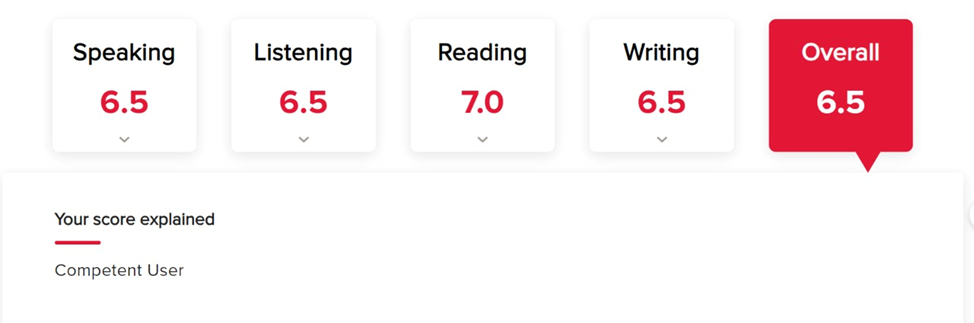
Thus, I passed the 'most famous international English language exam' with a score of 6.5. This corresponds to the B2 level according to the CEFR system (Common European Framework of Reference for Languages).
I'm glad if you found this interesting and read the article to the end. Ask questions in the comments, I'll be happy to answer.