
Let me recall the game. Peter tosses a coin until it lands heads. If heads comes up on the first toss, Peter pays Paul 1 ducat, on the second 2, on the third 4, and every further toss doubles the payout. The average of this game is infinite, yet no reasonable person will pay twenty ducats for it. That is the first of the four paradoxes from the first part.
The last of the four was about Peter rather than Paul. To run the game, Peter has to promise any payout: heads on the 41 st toss, for example, means more than a trillion ducats, 17 times all the gold ever mined. In 1977 the American mathematician Lloyd Shapley titled a paper about this as a question: “The St. Petersburg Paradox: A Con Game?”
Can the St. Petersburg game be run honestly? Nobody can honestly promise an unlimited payout, but Peter can promise a share of the bank instead of a sum: then the promise never exceeds what the bank holds, and the bank does not go bankrupt. We will go step by step through how this works and what happens to each paradox, starting with the fourth: it gives us the bank on which the other sections are built. A fifth paradox will appear along the way.
The fourth paradox: a bank that pays in shares
Suppose Peter has 1,000 ducats, about $450,000 (at about $450 per ducat, as we found in the first part). No promise of any payout can be made from that sum: a game with the first heads on the eleventh toss requires 1,024 ducats, and payouts of that size or larger come up on average once in 1,024 games.
Could the fee per game save Peter? No. In 1945 William Feller calculated how the average payout grows with the length of a series: roughly as half the binary logarithm of the number of games. This is Feller’s law from the first part: about 5 ducats per game in a series of a thousand games, 10 in a series of a million, 15 in a series of a billion. Whatever constant fee Peter charges, in a long enough series the average payout exceeds it, and from then on Peter on average pays more per game than the game brings in. The capital then runs out, and a Peter who pays in money goes bankrupt with probability 1, however many ducats the bank started with.
Ruin theory: the Poisson process of Lundberg and Cramér
Insurers have been working on this problem for more than a hundred years. The Swedish actuary Filip Lundberg (1876–1965) in his 1903 dissertation and Harald Cramér (1893–1985), a namesake of Gabriel Cramer from the next section, in a 1930 work described an insurer’s capital as follows. The capital starts at  , premiums come in at a constant rate, and losses arrive at random moments in a Poisson process: in each short interval of time a loss occurs with the same small probability, independently of the past. The sizes of the losses are random and independent.
If premiums exceed losses on average and very large losses are rare enough, the probability of ruin is bounded from above:  , where the number
 depends on the premium loading and the distribution of losses. As capital grows, the probability of ruin falls exponentially, but for finite it stays above zero.
In this model Peter’s games are the insurer’s losses. In the uncapped St. Petersburg game the average loss is infinite, the fee per game cannot exceed it, and Lundberg’s bound does not apply to Peter. Ruin with probability 1 already follows from Feller’s law: the sum of the payouts grows faster than the sum of the fees.
There will be no ruin if the obligation itself is changed. Let us divide the 1,000 ducats into 10,000 shares. A share is worth the capital divided by the number of shares: 0.1 ducat. Peter pays Paul not in ducats but in new shares. The capital does not change, there are more shares, and each becomes cheaper: the payout dilutes the shares. In ducats, such a payout is always less than the capital.
The bank also issues new shares against ducats: whoever puts ducats into the capital receives shares at the current price. The bank redeems them at the same price: the ducats leave the capital and the shares are destroyed. Capital and the number of shares change in the same proportion, so the share price does not change. Everyone who has put in ducats becomes a co‑owner of the bank. I will call anyone who owns shares a holder. All the holders together pay for Paul’s payout: it lowers the price of every share. So Peter is now not one person but all the holders.
This removes half of the fourth paradox: the bank cannot go bankrupt. The other half, whether whoever runs the game can be trusted, stays open until the end of the article.
The first paradox: a finite game
The first paradox was about the infinite average. Back in 1728 Gabriel Cramer proposed a way out: cap the payout. The coin is tossed as before, until the first heads, but, as Cramer wrote, “I am never able to receive more than  coins, however late comes the side of Heads”. The average is calculated like this: each payout is multiplied by its probability. Heads on the first toss pays 1 ducat with probability 1/2, which is half a ducat. Heads on the second pays 2 ducats with probability 1/4, again half a ducat. And so on: 24 tosses contribute half a ducat each, 12 ducats in total. Games longer than 24 tosses together have probability
 , and in them Peter pays ducats, which adds 1 more ducat. So the average is finite:
 .
A bank of shares needs a finite average: with an infinite one, no fee per game covers the payouts. I propose to get it differently from Cramer: by making the game itself finite. The coin is tossed no more than a set number of times, say 24, and if heads never comes up, Peter pays the largest payout. The payouts and their probabilities are the same as Cramer’s and the average is 13, but the game always ends by the 24 th toss. I call the largest number of tosses the game length.
The fee for a game in the bank I call a deposit. Paul pays it not in ducats but in shares: first Paul puts in ducats, receives new shares against them, and then makes the deposit with these very shares. The payout also comes in shares, and Paul can return them to the bank for ducats. We will work out the size of the deposit in the next section. Let Paul’s game length be seven tosses and the smallest payout 1 share. With heads on the first toss Paul receives 1 share, on the second 2, and so on, and with no heads in seven tosses the largest payout, 128 shares, with probability 1/128. The average payout is 4.5 shares. In general, a game of length  tosses has
 outcomes, and with the smallest payout
 its average is
 .
Paul's game outcome by outcome
Paul’s game: length 7 tosses, 8 outcomes, smallest payout 1 share. H stands for heads, T for tails.
tosses | payout, shares | probability | contribution to the average |
|---|---|---|---|
H | 1 | 1/2 | 1/2 |
TH | 2 | 1/4 | 1/2 |
TTH | 4 | 1/8 | 1/2 |
TTTH | 8 | 1/16 | 1/2 |
TTTTH | 16 | 1/32 | 1/2 |
TTTTTH | 32 | 1/64 | 1/2 |
TTTTTTH | 64 | 1/128 | 1/2 |
TTTTTTT | 128 | 1/128 | 1 |
The average payout is  shares.
The last row contributes a whole share: its probability equals that of the row before, and its payout is twice as large.
The longer the game, the larger the largest payout and the more it lowers the share price. So I introduce a limit: the largest payout is at most 12.5% of the number of shares, and then the share price falls by at most 11%. With 10,000 shares that is 1,250 shares: Paul’s game with a payout of 128 shares fits, while a game with a payout of 2,048 shares will not start until there are more shares.
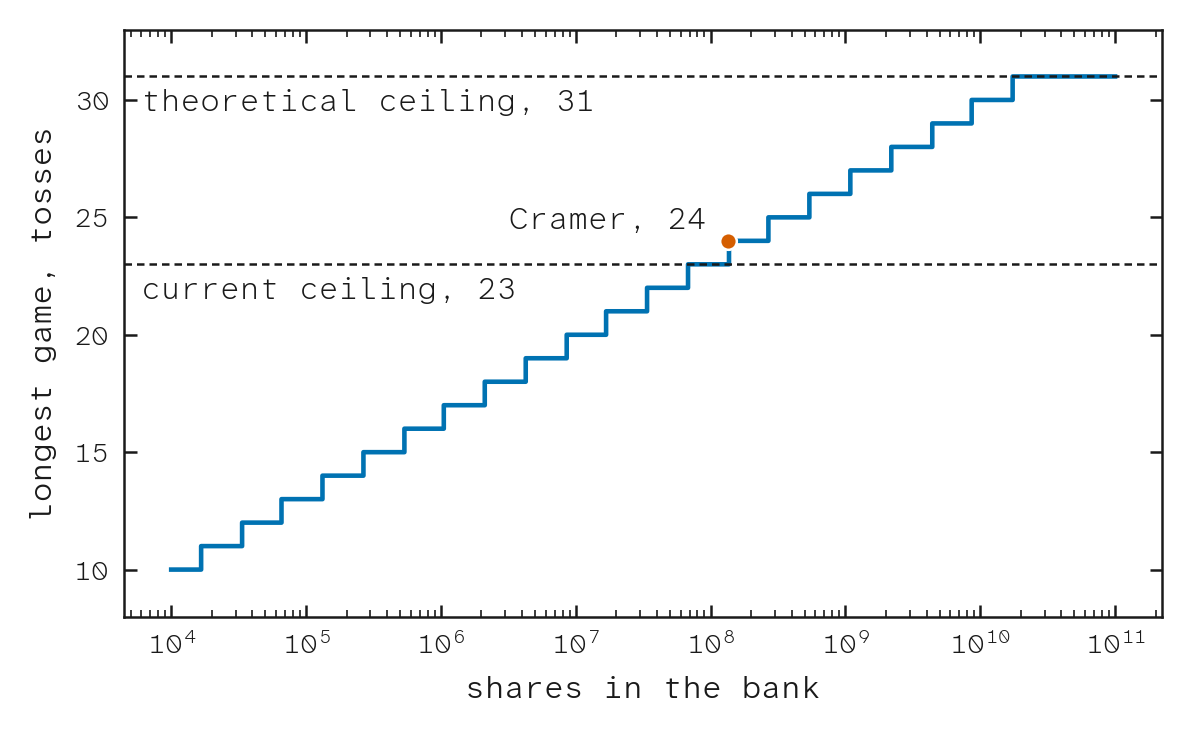
So the game length is set not by a choice “for the sake of simplicity”, as with Cramer, but by the size of the bank: for the same smallest payout, the more shares it has, the longer a game can be and the closer it comes to the original St. Petersburg game (figure 1). Besides the limit, the length is bounded by a ceiling: 31 tosses in theory, 23 at present, which is  .
What bank a game needs
With the 12.5% limit and a smallest payout of 1 share, leaving the present ceiling aside:
shares in the bank | game length, tosses | average payout, shares |
|---|---|---|
1,000,000 | 16 | 9 |
134,217,728 | 24, as with Cramer | 13 |
1,000,000,000 | 26 | 14 |
17,179,869,184 | 31, the theoretical ceiling | 16.5 |
The 12.5% figure was chosen in numerical experiments. To run Cramer’s game, Peter would need 58 tonnes of gold for one largest payout, about six days of world mine output. A bank of shares with a smallest payout of 1 ducat needs eight times as much, about 470 tonnes, but it does not go bankrupt after that payout.
The bank removes the first paradox differently from Cramer: the game is finite, so both the largest payout and the average are finite too.
The deposit that is destroyed
Now for the deposit. The deposit is not handed to anyone: the bank destroys it. The ducats against which these shares were issued stay in the capital, unlike in a redemption, so the capital is unchanged, there are fewer shares, and each share becomes more expensive. The payout works the other way: new shares are issued, and each becomes cheaper. The simplest order is to destroy the whole deposit at the start of the game and to issue the payout at the end; in the section on fees this order will have to change.
Who pays for the payout: an example
The bank has 1,000 ducats and 10,000 shares, and a share costs 0.1 ducat. There are two holders: the first has 8,000 shares, the second 2,000.
Paul puts in 80 ducats and receives 800 new shares against them. The capital is 1,080 ducats, there are 10,800 shares, and the price is unchanged.
Paul makes the deposit with these shares, and the bank destroys them. The capital is still 1,080 ducats, there are 10,000 shares, and a share costs 0.108 ducat.
Paul receives a payout of 1,250 shares. There are now 11,250 shares, and a share costs 0.096 ducat.
who | at the start, ducats | at the end, ducats | result, ducats |
|---|---|---|---|
first holder | 800 | 768 | −32 |
second holder | 200 | 192 | −8 |
Paul | 80 | 120 | +40 |
total | 1,080 | 1,080 | 0 |
Paul put in 80 ducats and, on returning the shares to the bank, will take out 120. The extra 40 ducats were lost by the holders: they paid nothing themselves, their shares simply became cheaper. With a payout smaller than the deposit it is the other way round: with a payout of 200 shares Paul will take out about 21 ducats, and the remaining 59 of the 80 will go to the holders.
Consider a fair game first: the deposit equals the average payout, 4.5 shares in Paul’s game, and on average Paul gets back as much as was put in.
But there is a catch: a fair game gives Peter almost nothing. Take a holder of 100 shares: before the game they are worth 10 ducats, after a payout of 1 share 10.0035, after a payout of 128 shares 9.878, and on average 10.00002. There is no payment for the risk of a payout, so someone who avoids risk has no reason to hold shares, and without holders the bank is small and the largest payout is small.
So it makes sense to set the deposit above the average payout. An insurer does the same: the premium is above the average loss, and actuaries call the difference the loading. The loading is set by a parameter of the bank: the average payout is 87.5% of the deposit. Let us write down the deposit:
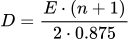
Paul’s deposit  is 5.14 shares. The loading is destroyed too, so it goes to those who bear the risk of a payout, to each in proportion to the number of shares held, as long as no shares are issued against ducats or redeemed during the game.
Paul's game for a holder of 100 shares
moment | shares in the bank | share price, ducats | holder’s 100 shares, ducats |
|---|---|---|---|
before the game | 10,000 | 0.100000 | 10.0000 |
deposit destroyed | 9,994.86 | 0.100051 | 10.0051 |
payout of 1 share, probability 1/2 | 9,995.86 | 0.100041 | 10.0041 |
payout of 128 shares, probability 1/128 | 10,122.86 | 0.098786 | 9.8786 |
In Paul’s game, on average 0.64 shares more are destroyed than issued, and with 10,000 shares the share price rises by 0.0064%.
Suppose no shares are issued against ducats or redeemed, and the payouts received are deposited again. If the sum of all deposits is  and there were
 shares at the start, then with exactly average payouts the share price grows by a factor of
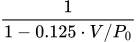
For example, 1,944 of Paul’s games with 10,000 shares give a sum of deposits of 10,000 shares and growth by a factor of 1.14. How many people are playing does not matter here, only the deposits and the number of shares. Individual series depart from this formula, the more so the rarer the large payout (figure 2).
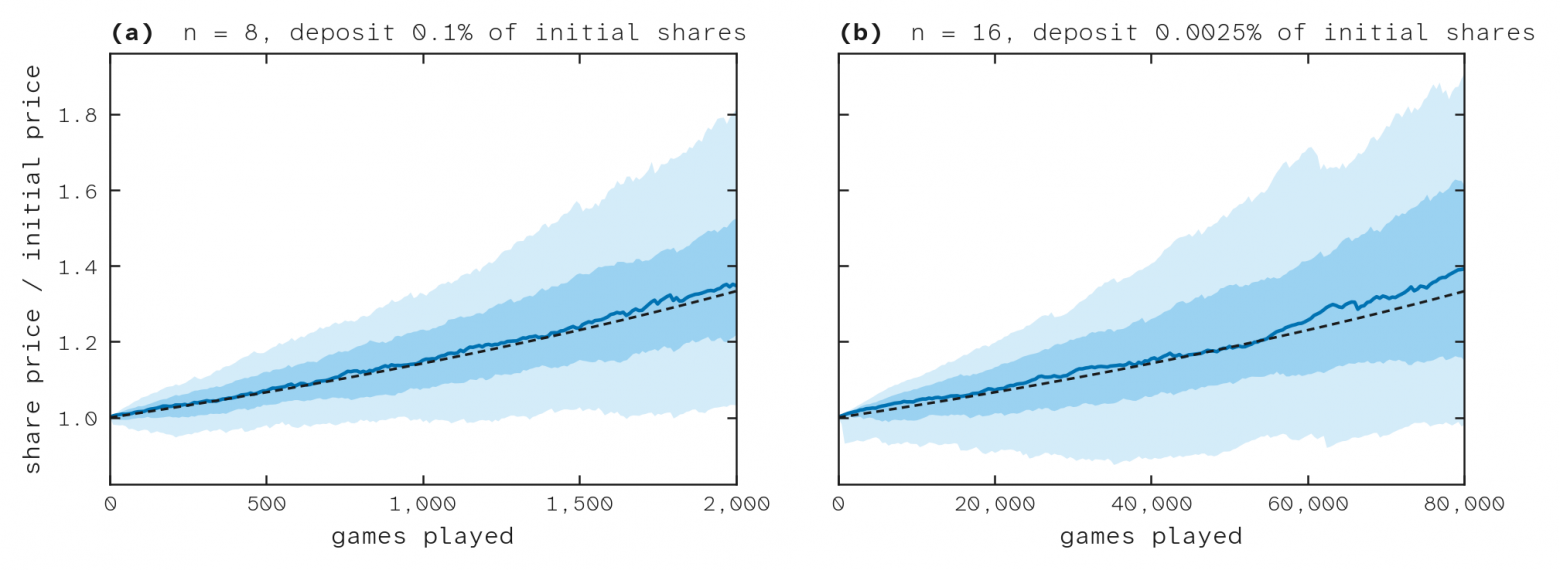
 (b) the band is wider than for
 (a): large payouts are rarer but bigger.
A game of this kind, in which the deposit is destroyed and the payout is issued in new shares, I will call mining from now on. The word comes from Bitcoin, and the connection is not only in the name: the two kinds of mining share the same mathematics.
Bitcoin mining and the St. Petersburg game
In Bitcoin a new block is added by whoever first finds a number whose hash is below a set threshold. With a threshold of  this means that the hash starts with
 zero bits. Each bit of a hash is zero with probability 1/2, like Peter’s coin, so such a hash turns up with probability
 , and finding one takes on average
 attempts. Satoshi Nakamoto wrote in the 2008 paper: “The average work required is exponential in the number of zero bits required”.
If the coin is replaced by a random number (how to obtain one honestly is described in the section on Blum’s scheme), Paul’s game counts the same thing: the number of one bits in a row. tails before the first heads are as rare as zero bits at the start of a hash. With ones Paul receives  : the payout is proportional to the number of attempts a Bitcoin miner would need on average to find the same result. On eight bits instead of 256 it looks like this:
Bitcoin: zero bits at the start of the hash.
hash | leading zero bits, k | attempts on average |
|---|---|---|
1011 0010 | 0 | 1 |
0101 1010 | 1 | 2 |
0010 1100 | 2 | 4 |
0001 0110 | 3 | 8 |
0000 0001 | 7 | 128 |
Paul’s game: one bits in a row from the lowest bit, right to left. Smallest payout 1 share, 8 outcomes.
random number | one bits in a row, k | payout, shares |
|---|---|---|
0100 1010 | 0 | 1 |
0110 1001 | 1 | 2 |
1001 0011 | 2 | 4 |
0110 0111 | 3 | 8 |
0111 1111 | 7 | 128 |
1111 1111 | 7: at most 7 bits are counted | 128 |
Each extra zero bit doubles the number of attempts, and each extra one doubles the payout. The last row shows the limit on the game length: the number has eight ones, and the payout is the same.
There is also a similarity in how new units are issued: a Bitcoin miner spends electricity and receives new coins, Paul spends a deposit and receives new shares.
Three operations with shares and two strategies
To a first approximation, there are three things you can do with shares: get them for ducats, return them to the bank for ducats, and deposit them for mining. Issue against ducats and redemption do not change the share price. Only mining changes it: the destroyed deposit raises the price, and a payout in new shares lowers it.
So far Peter and Paul have been people. What if they are not people but strategies? Peter’s strategy: get shares for ducats and hold them, with price growth from other people’s deposits and the risk of other people’s payouts. Paul’s strategy: get shares for ducats and mine with them, giving up on average 12.5% of the deposit for the chance of a large payout. I will call those who follow Paul’s strategy miners.
The fifth paradox: demand and price
Usually a price rises when people buy and falls when they sell, and a mass departure of depositors means collapse for an ordinary bank.
A bank of shares has no seller: when there is demand, new shares are issued against ducats, when people leave, shares are redeemed, and the price does not change. But the growth from destroyed deposits is divided among all the shares. 1,944 of Paul’s games with 10,000 shares raise the price by a factor of 1.14. If half the holders have left, the same games give growth by a factor of 1.33, and if there are twice as many shares, by a factor of 1.07. It turns out that an inflow of holders slows the growth, and a departure speeds it up.
The contradiction disappears once you recall what the share price is. It is not the result of bargaining but the ratio of capital to the number of shares, just as in the essay “Of Money” (1752) by David Hume (1711–1776) prices follow the ratio of money to commodities. Issue against ducats changes both quantities, a game only the number of shares.
The conclusion rests on a condition: the miners stay. But the smaller the bank, the smaller the largest payout, and the miners may leave after the holders; we will return to this link in the section on symbiosis.
The second paradox: a series of games
The second paradox was about the series: by common sense the average payout over many games settles down, while by Feller’s law it grows without limit. In the first part a child, whom the French naturalist Buffon had asked to toss the coin, played 2,048 games and received on average 4.9 écus per game, although the average of the game is infinite: the largest payouts simply did not come up in that series. Does this paradox remain in the bank?
What matters to a holder is the destroyed fraction: the sum of deposits minus the sum of payouts, divided by the sum of deposits. On average it is 12.5%. Whether it settles at this number depends on how many games have been played compared with  : about that many games are needed for the largest payout to have time to come up.
If there are many more games than , there is no paradox. By the law of large numbers the destroyed fraction is close to 12.5% (figure 3 a): for a thousand games with  , in 95% of series it lies within 12.5% ± 5.0 percentage points.
If there are many fewer games than , the paradox remains, and the series follows Feller’s law (figure 3 b): as with Buffon, the large payouts have not come up yet, so the average payout is small, and usually more than 12.5% is destroyed. For a thousand games with the median destroyed fraction is 56%. The average stays at 12.5% thanks to rare series: in about 9% of them more new shares have been issued than destroyed. The median approaches 12.5% only when the number of games reaches about , that is, 17 million. Buffon’s child, playing one game per second, would need more than six months without sleep for that.
To shorten this time, the bank can lower the ceiling on the game length: the shorter the game, the smaller and the sooner the destroyed fraction approaches 12.5%.
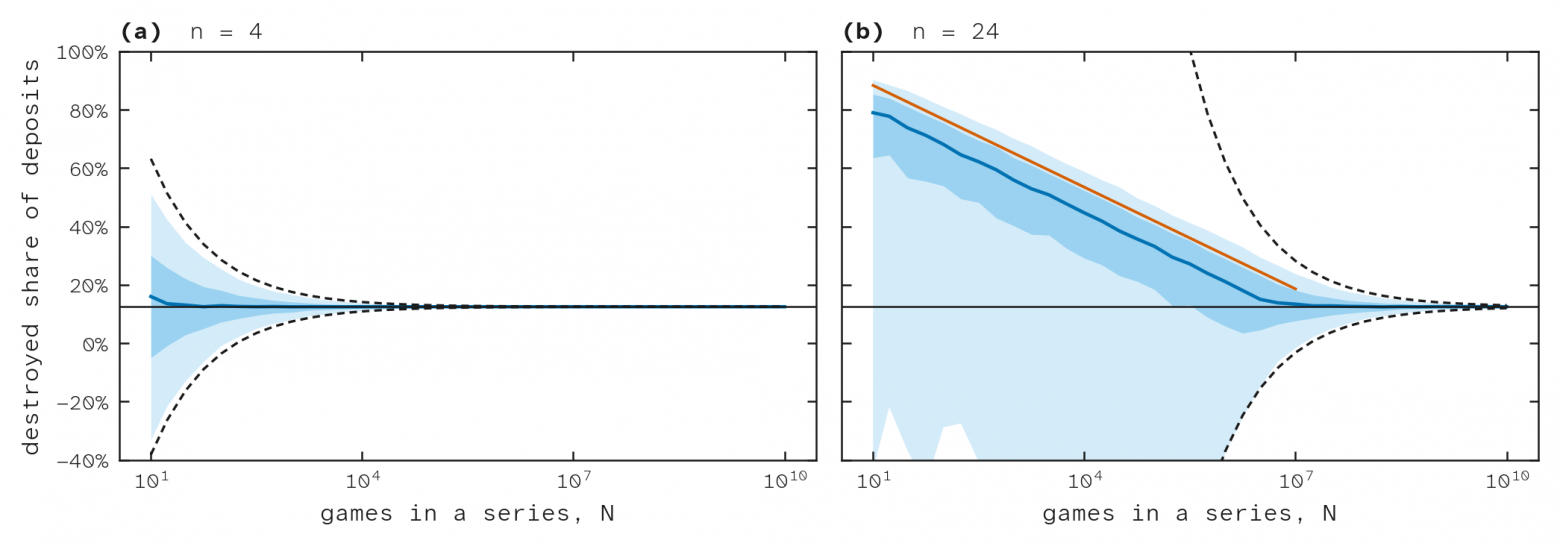 (a) and (b): median, 25–75% and 5–95% of 2,000 series. The solid line shows 12.5%. The dashed lines show the bounds of 95% of series by the central limit theorem. The orange line shows Feller’s law.
So the bank removes the second paradox on one condition: there must be many more games than . While there are fewer, the paradox still operates, only now in favour of the holders: Paul usually receives less than the average, while the holders’ shares become more expensive faster than average and only rarely, after a large payout, end up cheaper than at the start of the series.
The third paradox: who will play
The third paradox was about people. The same person insures a house and buys a lottery ticket. By Daniel Bernoulli’s theory, in which the utility of money, its value to a person, grows as the logarithm of wealth, this cannot happen: someone who insures will not buy a ticket that costs more than its average payout. So who will play with a bank of shares?
A person with logarithmic utility will not play: such a person pays no more than the average payout for a game, and the bank charges more. The players can be those who pay more than the average for a small chance of a large sum. Milton Friedman and Leonard Savage described such a person in 1948, and Daniel Kahneman and Amos Tversky showed that many people behave this way. The loading is the same for any game length, and Paul chooses the shape of the risk: with  the payout is 0.58 or 1.17 deposits, while with it is below the deposit in 15 games out of 16, but the largest is 587,203 deposits.
The shape of the risk at different game lengths
Payouts are given in deposits.
n | smallest payout | largest payout | chance of more than the deposit | chance of the largest |
|---|---|---|---|---|
2 | 0.58 | 1.17 | 50% | 1 in 2 |
8 | 0.19 | 25 | 12.5% | 1 in 128 |
16 | 0.10 | 3,373 | 6.25% | 1 in 32,768 |
24 | 0.07 | 587,203 | 6.25% | 1 in 8,388,608 |
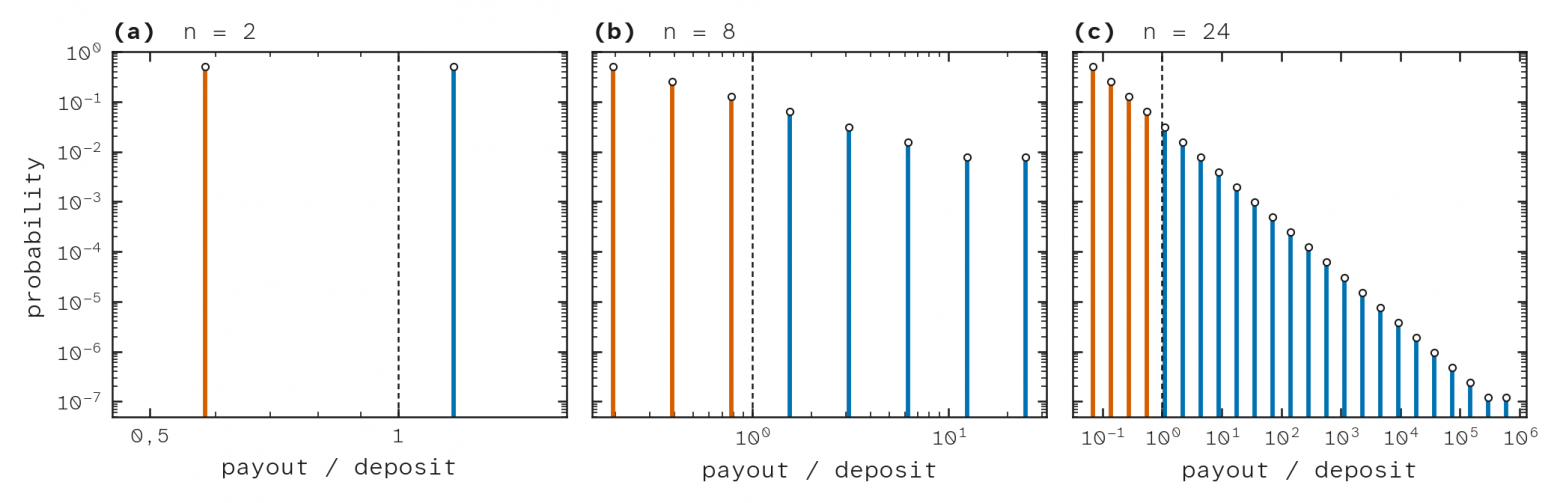 = 2, 8 and 24; the payout is given in deposits. Orange outcomes bring less than the deposit, blue ones more.
The bank does not resolve the third paradox but uses it: the bank needs such people to exist, and why they pay more than the average for a chance does not matter.
The symbiosis of holders and miners
In a game the capital does not change, so whatever a miner gains in ducats, the holders lose: in ducats this is a zero‑sum game. In utility the sum is not zero. Bernoulli’s insurance problem works the same way: a merchant pays an insurer more than the average loss, and the deal benefits both, because the same risk is large for the merchant and small for the insurer. A miner pays the loading for a chance of a sum that the miner needs, and a holder bears a small part of the risk of many other people’s games.
The result of each strategy also depends on how many people chose the other one. Miners need holders: the payout limit is 12.5% of the number of shares, and the more shares are issued against the holders’ ducats, the larger the largest payout. Holders need miners: without games the share price does not grow. Biologists call such a link between two species symbiosis.
The two dependencies close into a circle. In 1993 the American economists Philip Cook and Charles Clotfelter showed, using data from US states, that people pay for a small chance of a large sum the more willingly, the larger the sum. If this is also true of miners, the circle looks like this: more holders, a larger largest payout, more miners, more destroyed deposits, faster growth of the share price, more holders.
The circle has a limit too, the same as in the fifth paradox: the faster shares are issued against ducats, the more slowly the price grows and the less profitable it is to hold them. I modelled an inflow of participants: the bank grows to a stable size if miners are added more slowly than the largest payout grows, and otherwise it grows as long as there are new participants. This is a model of behaviour, not a rule of the bank.
Why the bank needs fees
The rules of the bank are open, and anyone can look for a vulnerability in them. One is related to arbitrage. At the start of a game the deposit is destroyed and shares become more expensive, while the payout is issued later. Whoever gets shares for ducats just before someone else’s game starts and returns them before the payout gets the price rise without the risk of the payout. So issue against ducats and redemption need a fee, 1.5625% each. Then such a trade pays off only if more than 3.1% of all shares are destroyed at the start of the game, and in Paul’s game it is 0.05%.
The fee does not close the second vulnerability, so the order of destruction has to change. Paul will receive the smallest payout whatever the outcome, so at the start of the game only the deposit minus the smallest payout,  , is destroyed, and at the end only the payout above the smallest is issued. In Paul’s game the deposit is 5.14 shares and the smallest payout is 1 share, so 4.14 shares are destroyed at the start, and with a payout of 128 shares 127 new ones are issued at the end. The result for the holders is the same. I leave it to you to find which vulnerability the new order closes.
Trust in the toss: Blum’s scheme
Let us return to the second half of the fourth paradox, to trust. Paul would have to trust Peter twice: that the coin is tossed honestly and that the payout is made. Let us start with the coin. In Bernoulli’s version Peter tosses it, in Buffon’s a child did. We will keep children out of this. Can a coin be tossed so that neither Peter nor Paul chooses the outcome?
In 1983 the American computer scientist Manuel Blum (born 1938) published the paper “Coin Flipping by Telephone”: how two people who do not trust each other can honestly toss a coin at a distance.
In the paper Alice and Bob have recently divorced, live in different cities and want to toss a coin by telephone to decide who gets the car. If Alice tosses, Bob has to take Alice’s word for it. Blum changes the order of moves. Alice picks heads or tails and gives Bob only a commitment: a number from which the choice cannot be recovered but against which it can be checked. Bob names a guess, Alice reveals the choice, and Bob checks it against the commitment. Alice cannot change the choice after Bob’s move.
In the bank Paul is in Alice’s place and an external source of random numbers is in Bob’s; the holders take no part in the toss:
Paul chooses a secret and publishes its hash before the game starts. The secret cannot be recovered from the hash, but a revealed secret can be checked against it.
The source publishes a random number with a signature. The bank’s rules accept only a signature by the key specified at the start of the game.
Paul reveals the secret, and the secret is added to the number modulo 2 (XOR).
Each bit of the result is one with probability 1/2, like the coin, so the number of ones in a row, up to , is distributed as the number of tails before the first heads.
If Paul does not reveal the secret in time, only the smallest payout is paid, so hiding a bad outcome is pointless.
Neither Paul nor the source can choose the outcome alone: Paul publishes the hash before the number and cannot predict the number, and the source has access only to the hash. Buffon had to trust a child. Here the secret and the number are public, and anyone can recalculate the result.
Trust in the payout: rules in code
Shapley’s question from the start of the article remains: will Peter pay? As long as a person carries out the rules, Paul has to trust that person.
The rules of such a bank can be written into the code of a blockchain contract. The network runs this code, not a person, and anyone can check every operation. The outcomes and probabilities are written in the code in advance, the payout arrives in full, and a holder can return shares to the bank at the current price at any moment: nobody can stop redemption, including whoever set up the bank.
This removes the second half of the fourth paradox as well.
The PARADOX (PRDX) protocol
A protocol with these rules exists: PARADOX (PRDX). It runs on the TON and Solana test networks with tokens of no real value, and its capital is held not in ducats but in the coins of the network.
protocol detail | what it is for |
|---|---|
payout in new shares | the capital never goes negative, whatever the payout |
payout limit of 12.5% of the number of shares | the size of the bank sets the largest payout; one payout lowers the share price by at most 11% |
loading: the average payout is 12.5% below the deposit | holders are paid for the risk of a payout; without this, someone who avoids risk has no reason to hold shares, and the capital is small |
destruction of the deposit | the loading goes to those who bear the risk, in the same proportion in which the payout dilutes them |
game length chosen by Paul | the shape of the risk is chosen by the one who pays for it |
fee of 1.5625% on issue against ducats and on redemption | issue and redemption around someone else’s game do not pay off if less than 3.1% of shares are destroyed at its start |
the smallest payout is not destroyed at the start of the game | closes the second vulnerability, which the reader is invited to find |
Blum’s scheme | neither Paul nor the random number source chooses the outcome alone |
the smallest payout if the secret is not revealed | refusing to reveal the secret gains nothing |
rules in code, redemption cannot be stopped | Paul does not need to trust Peter, and a holder can leave at any moment |
The limitations of the protocol, the proofs of the formulas and how the random number source works are described in the documentation: docs.prdxcoin.com. If you find an error in the calculations, please write in the comments.
References
Bernoulli D. Specimen theoriae novae de mensura sortis. Commentarii Academiae Scientiarum Imperialis Petropolitanae, 1738. English translation: Exposition of a New Theory on the Measurement of Risk, transl. L. Sommer. Econometrica, 1954.
Feller W. Note on the law of large numbers and “fair” games. Annals of Mathematical Statistics, 1945.
Shapley L. S. The St. Petersburg Paradox: A Con Game? Journal of Economic Theory, 1977.
Blum M. Coin Flipping by Telephone: A Protocol for Solving Impossible Problems. ACM SIGACT News, 1983.
Lundberg F. Approximerad framställning af sannolikhetsfunktionen. Uppsala, 1903.
Cramér H. On the Mathematical Theory of Risk. Skandia Jubilee Volume. Stockholm, 1930.
Hume D. Of Money. In: Political Discourses. Edinburgh, 1752.
Nakamoto S. Bitcoin: A Peer‑to‑Peer Electronic Cash System. 2008.
Cook P. J., Clotfelter C. T. The Peculiar Scale Economies of Lotto. American Economic Review, 1993.
Pulskamp R. J. (transl.). Correspondence of Nicolas Bernoulli concerning the St. Petersburg Game. 2013.
PARADOX (PRDX): protocol documentation. docs.prdxcoin.com, October 2026.