What camera form-factor should you choose?

This is a question asked by every second customer who comes to us for a video surveillance system. Everyone has their own preferences, so this is simply SpesLab’s personal view.

Internet of Things

This is a question asked by every second customer who comes to us for a video surveillance system. Everyone has their own preferences, so this is simply SpesLab’s personal view.

If you are using a LoRa module for point-to-point (P2P) communication or building your own private protocol, understanding and correctly configuring each parameter is the key to successful communication.
After reading this article, you will learn:
• How Should the LoRa Over-the-Air (PHY) Modulation and Packet Format Parameters Be Configured, and Why?
• The meaning of RF front-end parameters and how to tune them
• Chip-level control parameters: operating modes, clocks, power supply, calibration, and more
• A quick-reference "must-match" table and a list of common issues
Note: This article covers only LoRa (P2P/Private Protocol) parameters. If you need information on LoRaWAN protocol-layer parameters (e.g., ADR, DevEUI, join procedures), please refer to "LoRaWAN Protocol Layer Parameters".
Before starting configuration, verify that your device has selected PacketType = LoRa. The LR2021 supports multiple modulation types—including LoRa, LR-FHSS, FLRC, FSK/GFSK, OQPSK, and OOK. When using P2P LoRa communication, you must first switch to LoRa mode; all subsequent modulation and packet structure commands will then be interpreted in LoRa mode.
If you select the wrong PacketType (e.g., FLRC or GFSK mode), the chip will not interpret the SF, BW, and CR parameters in LoRa mode, The result is that the transmitted data cannot be decoded by the receiving end at all.

A categorical welcome to everyone. Literally on the first of August, right in the middle of the night, YouTube started lagging terribly for me. Naturally, I didn't like this at all. Well then, let's figure out why and how to fix it within my personal network.
What happened?
What happened is well described here, on Habr. In short, in my own words - during the SSL connection setup, the domain we are connecting to (the so-called SNI) is transmitted in plain text. And if it's googlevideo.com, then "interesting things" start to happen. You can check this locally with the commands from the article.
$ curl https://speedtest.selectel.ru/100MB -o/dev/null
Hello, Habr!
Today we'll look at how to install the network packet modification utility Zapret on Keenetic routers. Unlike using it on specific devices, installing it on a router allows you to process traffic from all devices connected to your home local network (PCs, smartphones, and smart TVs).

Much attention is currently focused on the size of neural networks and the gigawatts of power consumed by data centers. However, the future lies not only in giant clusters but also in tiny chips embedded directly into the sensing elements of hardware. When a neural network is placed directly inside a sensor chip, it must be exceptionally efficient.
Through experimentation, I have successfully built a neural network architecture with 380 parameters (with potential for further reduction), capable of operating in conditions considered unsuitable for conventional algorithms.

Wearable Digital Health Technologies for Monitoring in Cardiovascular Medicine
This review article presents a three-part true-life clinical vignette that illustrates how digital health technology can aid providers caring for patients with cardiovascular disease. Specific information that would identify real patients has been removed or altered. Each vignette is followed by a discussion of how these methods were used in the care of the patient.

Today I would like to discuss the games Chess and Go, the world's champions, algorithms and Al.
In 1997, a computer program developed by IBM Deep Blue defeated the world Chess champion Garry Kasparov. Go remained the last board game in which humans were still better than machines.
Why is that?
Chess is primarily distinguished from Go by the number of variations for each move. Chess, the game is more predictable with more structured rules: we have value for each figure (e.g bishop = 3 pawns, rook = 5 pawns -> rook > bishop), some kind of openings and strategies. Go, in turn, has incredibly simple rules, which creates the complexity of the game for the machine. Go is one of the oldest board games. Until recently, it was assumed that a machine was not capable of playing on an equal footing with a professional player due to the high level of abstraction and the inability to sort through all possible scenarios - exactly as many valid combinations in a game on a standard 19×19 go-ban are 10180 (greater than the number of atoms in the visible universe).
However, almost 20 years later, in 2015, there was a breakthrough. Google's Deep Mind company enhanced AlphaGo, which was the last step for the computer to defeat the world champions in board games. The AlphaGo program defeated the European champion and then, in March 2016 demonstrated a high level of play by defeating Lee Sedol, one of the strongest go players in the world, with a score of 4:1 in favour of the machine. A year later, Google introduced to the world a new version of AlphaGo - AlphaGoZero.

In this video, we are making a cable for connecting a quadrature encoder to a Servosila brushless motor controller, and and then running a servo motor in Direct Drive mode. To make the cable we are using a cable assembly kit that can be purchased from the internet store. Alternatively, the components for the cable can be bought in other places. The part numbers are given in the controller's datasheet.
The cable assembly kit consists of a connector and a set of wires with pre-crimped socket blades. If you have a crimper tool, you can also attach the socket blades to wires by yourself.
Lets open a datasheet document that comes with the brushless motor controller. Note that each connector has its first pin clearly marked with a "1" sign. Conventionally, the numbering of pins is done in such a way that there are rows of odd-numbered and even-numbered pins.
The quadrature encoder's electrical interface has 5 wires in total. Positions of the pins of each of the wires are given in the table. The socket blades need to be pushed into the connector until you feel a "click". The blades lock into the connector's sockets. Optionally, primarily for cosmetic reasons, you may want to add a heat-shrink tubing to your cable.
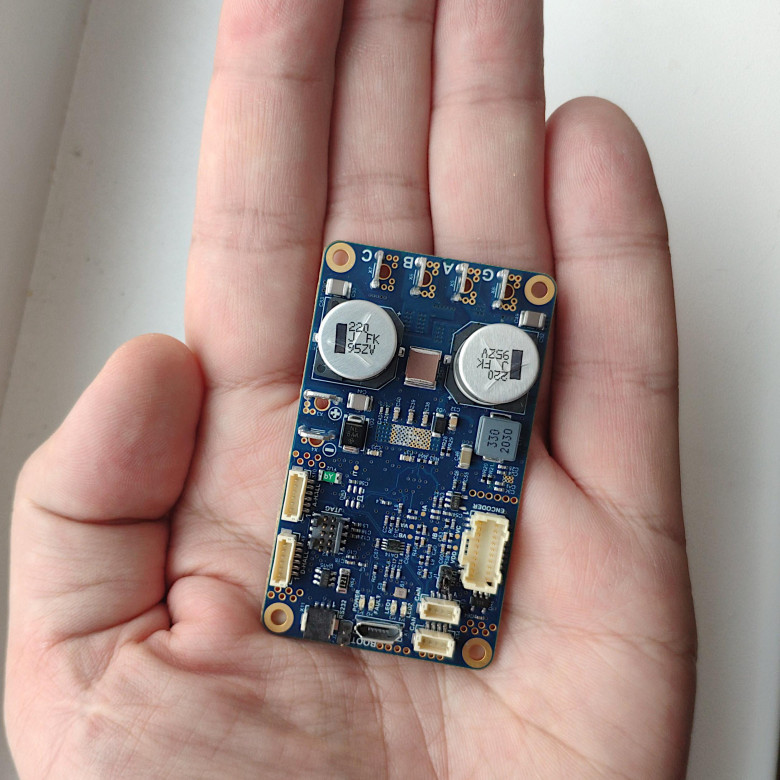
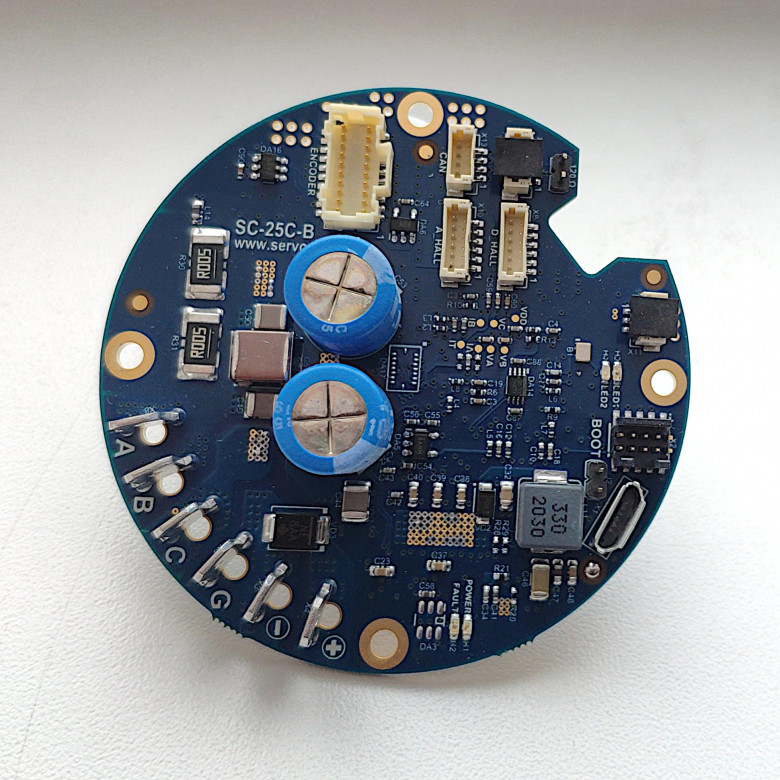
The brushless motor controllers come in two distinct forms, a circular and a rectangular one. Both models are identical in terms of capabilities, features, firmware, and external electrical connectors.
The connector has a locking mechanism that keeps it in place. I soldered a mating connector to the other side of the cable - a connector that my brushless motor needs. Note that your motor will likely require a different connector, or no connector at all. It is always a good idea to test an end-to-end integrity of the cable and its connectors. Lets buzz the wires using a multimeter. The cable is ready.

In this video, we will look at how to connect brushless motors to a Windows computer via USB. We are going to connect a network of Servosila brushless motor controllers to the computer. The other option is CANbus interface, but we will look at CANbus in a dedicated video. A regular USB cable is used. Note that the USB cable is not used to power the controller and its motor.
The first brushless motor controller in network appears to Windows as a Virtual COM port. Once connected via USB, it can be found in a general list of devices in the Window's "Settings" window. Up to 16 controllers can be connected this way via a single USB cable to the same control computer or a PLC. If one of the interconnected brushless motor controllers is connected to a computer via USB, then that particular controller becomes a USB-to-CANbus gateway for the rest of the network.
If your computer happens to have more that one serial port, you may wish to check a COM port's number assigned by Windows to the controller. Then, you pick this COM port in a drop down menu in the Servoscope software, and click Connect. If the COM port is not listed in the drop-down menu, click the Refresh button. If everything is good, the controller appears in a list of devices. Double-click to open up a control and configuration window.

In this video tutorial, we will control a pair of brushless motors from a Raspberry PI computer. We will use one of the computer's USB ports to connect a network of brushless motor controllers. We will power the computer, the controllers, and the brushless motors using a single battery, similar to a autonomous vehicle design.
The first motor is an outrunner type, a kind of what you would use for a vehicle propulsion. The bigger motor comes with a quadrature encoder which means it can be used as a powerful servo.
I made a cable to power my set up. On one end, the cable has a socket for plugging the battery. The cable splits into a two parallel parts to power the controllers, and the Raspberry PI. The bottom part of the cable further splits to power a pair of brushless motor controllers.
By the way, the controllers need 7 to 60 Volts DC. I put proper connectors at the ends of the cable, so that I could just plug it into the controllers.
Servosila brushless motor controllers come in rectangular or circular form factors. The controllers have USB and CANbus ports for connecting to control computers such as Raspberry PI.

Technology is as adaptable and compatible as mankind; it finds its way through problems and situations. 2020 was one such package of uncertain events that forced businesses to adapt to digital transformation, even to an extent where many companies started to consider the remote work culture to be a beneficiary long-term model. Technological advancements like Hyper automation, AI Security, and Distributed cloud showed how any people-centric idea could rule the digital era. The past year clearly showed the boundless possibilities through which technology can survive or reinvent itself. With all those learnings let's deep-dive and focus on some of the top technology trends to watch out for in 2021.

One of our readers recommended paying heed to the Espressif IoT Development Framework. He found an error in the project code and asked if the PVS-Studio static analyzer could find it. The analyzer can't detect this specific error so far, but it managed to spot many others. Based on this story and the errors found, we decided to write a classic article about checking an open source project. Enjoy exploring what IoT devices can do to shoot you in the foot.


Source: Google Images


Source: Google Images