Java vs .Net: Who will Reign in the Future?

Here we will see the battle between Java and Microsoft .Net in order to make this clear which language is better to choose. For that, you may also have a quick look at this short video:

General-purpose computer-programming language that is concurrent, class-based, object-oriented, and specifically designed to have as few implementation dependencies as possible


This is a post about first steps and first pitfalls in modernization of old enterprise application using "supersonic subatomic java" quarkus as it is positioned by RedHat.
In the end of 2019 I was invited to work in a project in our company, where an old monolithic application should be split into micro-services. Basic reasoning behind this decision was, that framework which is used in application is near to it's end-of-life. The application should be rewritten in any case. If it should be rewritten in any case, why not to split it into micro-services?
Since last 10 years, I was working mostly with java and we had in the project specialists with java knowledge, we have decided to give java-based frameworks a try for back-end functionality.
OK, let's use spring-cloud for that purpose, was our first thought. But then, we have had a look onto quarkus, which has been released in the end of 2019. We have decided to give it a try, keeping in mind building of native applications using GraalVM.
Native applications from our perspective could give us following benefits:
We were aware about possible drawbacks of this solution:


If you utilize Apache Spark, you probably have a few applications that consume some data from external sources and produce some intermediate result, that is about to be consumed by some applications further down the processing chain, and so on until you get a final result.
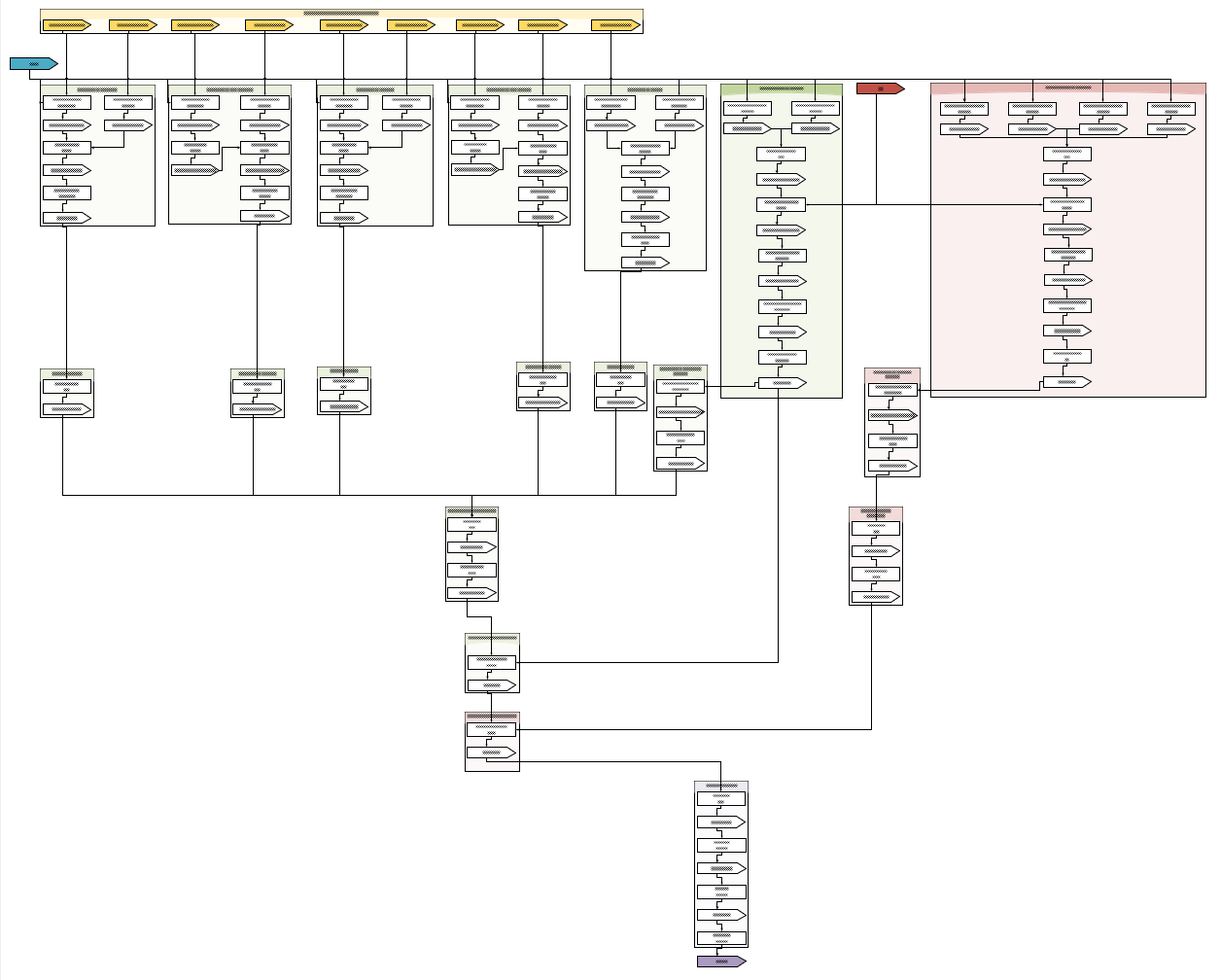
We suspect that because we have a similar pipeline with lots of processes like this one:

Click here for a bit larger version
Each rectangle is a Spark application with a set of their own execution parameters, and each arrow is an equally parametrized dataset (externally stored highlighted with a color; note the number of intermediate ones). This example is not the most complex of our processes, it’s fairly a simple one. And we don’t assemble such workflows manually, we generate them from Process Templates (outlined as groups on this flowchart).
So here comes the One Ring, a Spark pipelining framework with very robust configuration abilities, which makes it easier to compose and execute a most complex Process as a single large Spark job.
And we just made it open source. Perhaps, you’re interested in the details.

Who doesn’t know about Java today? You can hear its mention in every nook and corner of the world. A significant majority of IT companies provide Java-based applications, while businesses are still driven to secure java applications due to robustness and stringent security facilities. However, Java frameworks are a matter of chaos for a variety of business owners that want their application to be standout.
The fact is that there is no dearth of java frameworks that makes application development simple and efficient. However, a number of people have a query regarding the selection of java framework on the basis of features, ease-of-use, cost, and many more. Businesses hire programmers in India, though they stay confused on which platform they want their app to be created.


<dependency>
<groupId>com.github.michaelgantman</groupId>
<artifactId>MgntUtils</artifactId>
<version>1.7.0.5</version>
</dependency>
<dependency>
<groupId>com.github.michaelgantman</groupId>
<artifactId>MgntUtils</artifactId>
<version>1.7.0.5</version>
<classifier>javadoc</classifier>
</dependency>
<dependency>
<groupId>com.github.michaelgantman</groupId>
<artifactId>MgntUtils</artifactId>
<version>1.7.0.5</version>
<classifier>sources</classifier>
</dependency>


const map = (transformFunction, array1) =>
array1.reduce((newArray1, xyz) =>
{
newArray1.push(transformFunction(xyz));
return newArray1;
},
[]
);
const double = (x) => x * 2;
const reverseString = (string) =>
string
.split('')
.reverse()
.join('');
map(double, [200, 300, 400]);
Output: [400, 600, 800]
map(reverseString, ['Hello Alka', 'I love cooking']);
// ['alkA olleH', ‘gnikooc evol I']

Swoft is a PHP high performance microservice coroutine framework. It has been published for many years and has become the best choice for php. It can be like Go, built-in coroutine web server and common coroutine client and is resident in memory, independent of traditional PHP-FPM. There are similar Go language operations, similar to the Spring Cloud framework flexible annotations.
Through three years of accumulation and direction exploration, Swoft has made Swoft the Spring Cloud in the PHP world, which is the best choice for PHP's high-performance framework and microservices management.

X=np.array([[0,1,1,0],[0,1,1,1],[1,0,0,1]])
y=np.array([[0],[1],[1]])
def sigmoid ():
return 1/(1 + np.exp(-x))
def derivatives_sigmoid ():
return x * (1-x)epoch=10000
lr=0.1
inputlayer_neurons = X.shape[1]
hiddenlayer_neurons = 3
output_neurons = 1
wh=np.random.uniform(size=(inputlayer_neurons,hiddenlayer_neurons))
bh=np.random.uniform(size=(1,hiddenlayer_neurons))
wout=np.random.uniform(size=(hiddenlayer_neurons,output_neurons))
bout=np.random.uniform(size=(1,output_neurons))

Working with SOAP often gets tricky, and dealing with WSDL might be a huge contribution to the complexity of this task. Really, it could be the least expected thing to face when you are into a modern & fancy language like for example, Scala, that is well known for its reactiveness and asynchronous way of dealing with requests. In fact, many of the software developers that have made their way into industry quite recently, might not even know about SOAP and WSDL protocols, and get quickly annoyed or even enraged when first trying to connect to such a legacy service. So, should we deprecate this altogether in favour of modern technology stack, or maybe there is a less painful solution?