New Dark Theme Available on Visual Studio App Center
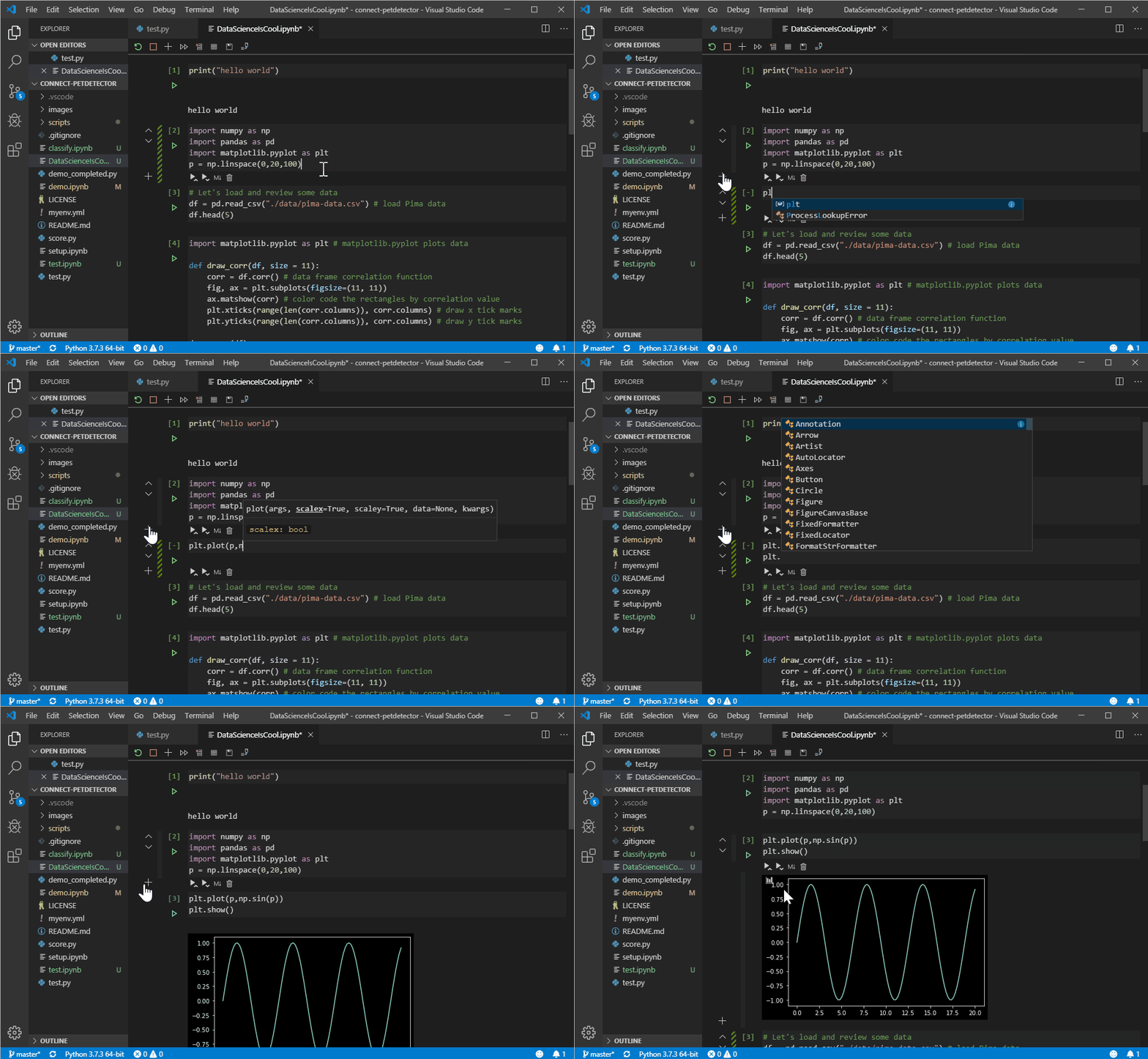
In the next few screens, you can get an idea of how App Center’s dark theme looks:

App Center Distribute in Dark theme

App Center Test in Dark theme

The art of creating computer programs


A few days ago 0xd34df00d has published the translation of the article, describing the possible information about some function if we use it as a "black box", not trying to read its implementation. Of course, this information is quite different from language to language; in the original article, four cases were considered:
"Here's C and there's Haskell, and what about Rust?" — this was the first question in the following discussion. The reply is here.
Have you ever looked for a flat? Would you like to add some machine learning and make a process more interesting?

Talking to people at conferences and in comments to articles, we face the following objection: static analysis reduces the time to detect errors, but takes up programmers' time, which negates the benefits of using it and even slows down the development process. Let's get this objection straightened out and try to show that it's groundless.

>>> class A:
... x = 2
...
>>> A.x
2
>>> A().x
2

In this article, I would like to propose an alternative to the traditional test design style using functional programming concepts in Scala. This approach was inspired by many months of pain from maintaining dozens of failing tests and a burning desire to make them more straightforward and more comprehensible.
Even though the code is in Scala, the proposed ideas are appropriate for developers and QA engineers who use languages supporting functional programming. You can find a Github link with the full solution and an example at the end of the article.


Many programmers struggle when using formal methods to solve problems within their programs, as those methods, while effective, can be unreasonably complex. To understand why this happens, let’s use the model checking method to solve a relatively easy puzzle:


Hi, my name is Michael Kapelko. I have been developing software professionally for more than 10 years. I develop games and game development tools in my spare time.
This article describes my first durable application for desktop PCs: PSKOV static site generator.
Durability
A durable application is an application that functions without a single change on operating systems released in years 2010-2030. In other words, a durable application has backward compatibility of 10 years and has the stability to run for 10 years. Actually, PSKOV runs even under Windows 2000, so PSKOV has backward compatibility of 19 years.

User interfaces of modern enterprise applications are quite complex. You, as a developer, often need to implement in-app navigation, validate user input, show or hide screens based on user preferences. For better UX, your app should be capable of saving state to the disk when the app is suspending and of restoring state when the app is resuming.
ReactiveUI provides facilities allowing you to persist application state by serializing the view model tree when the app is shutting down or suspending. Suspension events vary per platform. ReactiveUI uses the Exit event for WPF, ActivityPaused for Xamarin.Android, DidEnterBackground for Xamarin.iOS, OnLaunched for UWP.
In this tutorial we are going to build a sample application which demonstrates the use of the ReactiveUI Suspension feature with Avalonia — a cross-platform .NET Core XAML-based GUI framework. You are expected to be familiar with the MVVM pattern and with reactive extensions before reading this note. Steps described in the tutorial should work if you are using Windows 10 or Ubuntu 18 and have .NET Core SDK installed. Let's get started! Source code of the app described in this tutorial is available on GitHub.

if constexpr and generic lambdas so that code could use the type if it is defined, while still being accepted by the compiler (and being discarded) if the type is not defined.struct all the time.struct technique with an unqualified name. You can’t use it to probe a type that you didn’t import into the current namespace.