Pull to refresh
1020.24

Programming *

The art of creating computer programs

Show first
Rating limit
Level of difficulty

Modern Environment for React Native Applications

Reading time4 min
Reach and readers2.3K
In this article, we will consider the process of setting up a React Native environment using expo-cli, Typescript, and Jest.
Typescript will help us avoid development mistakes and write a more efficient mobile application.

Modern tools allow integrating Typescript into the development environment. We can also use VS Code that supports Typescript.

Integration with React Native will give us the opportunity to use the auto-completion service, code navigation, and refactoring.

Expo is a toolkit that simplifies the creation of native React applications. This tutorial will give you an idea of how you can quickly create native React applications using Expo.


Read more →

How to Catch a Cat with TLA+

Reading time3 min
Reach and readers2.1K
Many programmers struggle when using formal methods to solve problems within their programs, as those methods, while effective, can be unreasonably complex. To understand why this happens, let’s use the model checking method to solve a relatively easy puzzle:

Conditions


You’re in a hallway with seven doors on one side leading to seven rooms. A cat is hiding in one of these rooms. Your task is to catch the cat. Opening a door takes one step. If you guess the correct door, you catch the cat. If you do not guess the correct door, the cat runs to the next room.
Read more →

Riding the Web 3.0 wave

Reading time6 min
Reach and readers2K
Developer Christophe Verdot shares his experiences of recently taking the online course ‘Mastering Web 3.0 with Waves’.


What is your background? What motivated you to take the course?

I’ve been a web developer for about 15 years, working mostly as a freelancer.
Read more →

Tips and tricks from my Telegram-channel @pythonetc, July 2019

Reading time4 min
Reach and readers1.5K

It is a new selection of tips and tricks about Python and programming from my Telegram-channel @pythonetc.

Previous publications


You can’t mutate closure variables by simply assigning them. Python treats assignment as a definition inside a function body and doesn’t make closure at all.
Read more →

On the way to durable applications with PSKOV static site generator as an example

Reading time4 min
Reach and readers1.6K

Pskov's veche


Hi, my name is Michael Kapelko. I have been developing software professionally for more than 10 years. I develop games and game development tools in my spare time.


This article describes my first durable application for desktop PCs: PSKOV static site generator.


Durability


A durable application is an application that functions without a single change on operating systems released in years 2010-2030. In other words, a durable application has backward compatibility of 10 years and has the stability to run for 10 years. Actually, PSKOV runs even under Windows 2000, so PSKOV has backward compatibility of 19 years.

Read more →

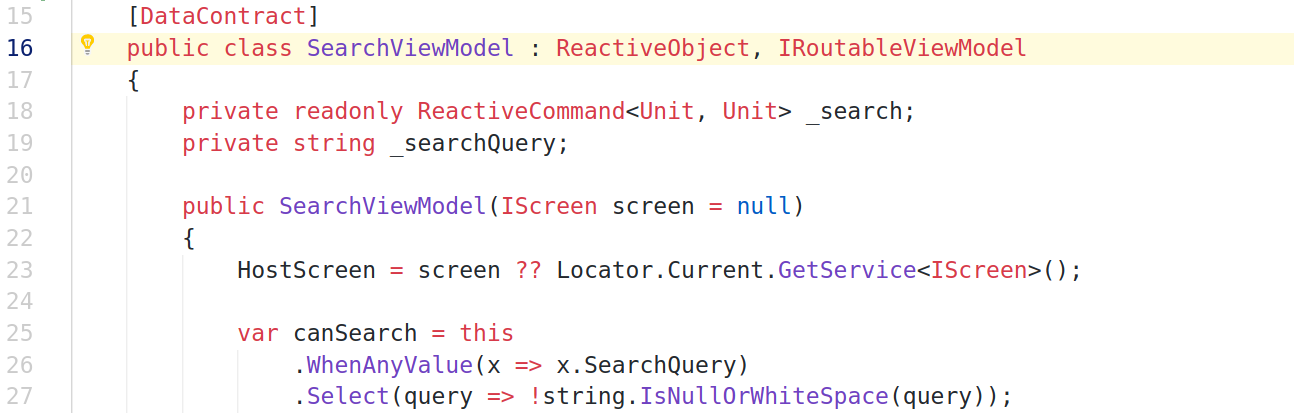
Saving Routing State to the Disk in a Cross-Platform .NET Core GUI App with ReactiveUI and Avalonia

Reading time17 min
Reach and readers10K

image


User interfaces of modern enterprise applications are quite complex. You, as a developer, often need to implement in-app navigation, validate user input, show or hide screens based on user preferences. For better UX, your app should be capable of saving state to the disk when the app is suspending and of restoring state when the app is resuming.


ReactiveUI provides facilities allowing you to persist application state by serializing the view model tree when the app is shutting down or suspending. Suspension events vary per platform. ReactiveUI uses the Exit event for WPF, ActivityPaused for Xamarin.Android, DidEnterBackground for Xamarin.iOS, OnLaunched for UWP.


In this tutorial we are going to build a sample application which demonstrates the use of the ReactiveUI Suspension feature with Avalonia — a cross-platform .NET Core XAML-based GUI framework. You are expected to be familiar with the MVVM pattern and with reactive extensions before reading this note. Steps described in the tutorial should work if you are using Windows 10 or Ubuntu 18 and have .NET Core SDK installed. Let's get started! Source code of the app described in this tutorial is available on GitHub.

Read more →

Python Vs R — Data Science

Reading time3 min
Reach and readers3.9K
When mulling over the best programming language to use for data science, Python and R ring a bell (very quickly). While there are a lot of languages like C, C++, Java, Julia, Perl, and Scala, it's protected to state that Python and R are the harbingers in data science.

While a great deal of data researchers will discuss the customary shortcomings like data wrangling in R or data representation in Python, ongoing improvements like Altair for Python or R have adequately reacted to these shortcomings.

So which one would it be a good idea for you to decide for your next data investigation venture?

R has been ruling this space for a long time now. This bodes well as this programming language was explicitly intended for analysts.
Read more →

What's the Use of Dynamic Analysis When You Have Static Analysis?

Reading time6 min
Reach and readers3K
In order to verify the quality of software, you have to use a lot of different tools, including static and dynamic analyzers. In this article, we'll try to figure out why only one type of analysis, whether static or dynamic, may not be enough for comprehensive software analysis and why it's preferable to use both.

Рисунок 1

Read more →

Announcing XAML Hot Reload for Xamarin.Forms

Reading time4 min
Reach and readers1.1K
Today at Xamarin Developer Summit, we announced XAML Hot Reload for Xamarin.Forms, which enables you to make changes to your XAML UI and see them reflected live, without requiring another build and deploy.

XAML Hot Reload for Xamarin.Forms speeds up your development and makes it easier to build, experiment, and iterate on your user interface. And this means that you no longer have to rebuild your app each time you tweak your UI – it instantly shows you your changes in your running app!

When your application is compiled using XAML Hot Reload, it works with all libraries and third-party controls. It will be available for iOS and Android in Visual Studio 2019 and Visual Studio 2019 for Mac. This works on all valid deployment targets, including simulators, emulators, and physical devices.

XAML Hot Reload will be available later in 2019, but you can sign up to to participate in the preview phase:

Sign Up for the Preview Now

Read more →

Detecting in C++ whether a type is defined: Predeclaring things you want to probe

Reading time4 min
Reach and readers3.2K
Last time, we used SFINAE to detect whether a type had a definition, and we used that in combination with if constexpr and generic lambdas so that code could use the type if it is defined, while still being accepted by the compiler (and being discarded) if the type is not defined.

However, our usage had a few issues, some minor annoyance, some more frustrating.

  • You had to say struct all the time.
  • If the type didn’t exist, the act of naming it caused the type to be injected into the current namespace, not the namespace you expected the type to be in.
  • You must use the struct technique with an unqualified name. You can’t use it to probe a type that you didn’t import into the current namespace.

We can fix all three of the problems with a single solution: Predeclare the type in the desired namespace.

Read more →

Configuration file htaccess

Reading time8 min
Reach and readers11K
Let’s begin from a far distance with the goal that the novices can see how the file described in the article works. To work the website on the Internet, you need not just a PC and access to the network, yet additionally, extraordinary programming introduced on it, which gives access to information utilizing the HTTP and HTTPS conventions. This product is the web server. There are different sorts of web servers, however, the most widely recognized is Apache. It is based on the open-source code, free, is continually being improved and enhanced, compatible with many scripts, and works on almost all platforms, including Windows, Linux, Netware 5.x.
Read more →

Checklist for writing great Visual Studio extensions

Reading time3 min
Reach and readers1.3K
Great Visual Studio extensions share a few key features that sets them apart from the rest. They look and feel well crafted, are performant and reliable, do what they advertise to perfection, and blend in naturally among Visual Studio’s own features.

To make it easier to write great extensions, we’ve worked with the extensibility community to come up with a simple checklist to follow. There’s even a GitHub issue template you can use so you remember to go through the checklist.

Read more →

A declarative data-processing pipeline on top of actors? Why not?

Reading time21 min
Reach and readers2.8K

Some time ago, in a discussion on one of SObjectizer's releases, we were asked: "Is it possible to make a DSL to describe a data-processing pipeline?" In other words, is it possible to write something like that:


A | B | C | D


and get a working pipeline where messages are going from A to B, and then to C, and then to D. With control that B receives exactly that type that A returns. And C receives exactly that type that B returns. And so on.


It was an interesting task with a surprisingly simple solution. For example, that's how the creation of a pipeline can look like:


auto pipeline = make_pipeline(env, stage(A) | stage(B) | stage(C) | stage(D));

Or, in a more complex case (that will be discussed below):


auto pipeline = make_pipeline( sobj.environment(),
        stage(validation) | stage(conversion) | broadcast(
            stage(archiving),
            stage(distribution),
            stage(range_checking) | stage(alarm_detector{}) | broadcast(
                stage(alarm_initiator),
                stage( []( const alarm_detected & v ) {
                        alarm_distribution( cerr, v );
                    } )
                )
            ) );

In this article, we'll speak about the implementation of such pipeline DSL. We'll discuss mostly parts related to stage(), broadcast() and operator|() functions with several examples of usage of C++ templates. So I hope it will be interesting even for readers who don't know about SObjectizer (if you never heard of SObjectizer here is an overview of this tool).

Read more →

Write Better Code Faster with Roslyn Analyzers

Reading time3 min
Reach and readers4.9K
Roslyn, the .NET compiler platform, helps you catch bugs even before you run your code. One example is Roslyn’s spellcheck analyzer that is built into Visual Studio. Let’s say you are creating a static method and misspelled the word static as statc. You will be able to see this spelling error before you run your code because Roslyn can produce warnings in your code as you type even before you’ve finished the line. In other words, you don’t have to build your code to find out that you made a mistake.


Roslyn analyzers can also surface an automatic code fix through the Visual Studio light bulb icon that allows you to fix your code immediately.

Read more →

Lua in Moscow 2019: Interview with Roberto Ierusalimschy

Reading time19 min
Reach and readers2.9K


Some time ago, the creator of Lua programming language, Roberto Ierusalimschy, visited our Moscow office. We asked him some questions that we prepared with the participation of Habr.com users also. And finally, we’d like to share full-text version of this interview.
Read more →

Simplify Your Code With Rocket Science: C++20’s Spaceship Operator

Reading time8 min
Reach and readers2.7K
C++20 adds a new operator, affectionately dubbed the «spaceship» operator: <=>. There was a post awhile back by our very own Simon Brand detailing some information regarding this new operator along with some conceptual information about what it is and does. The goal of this post is to explore some concrete applications of this strange new operator and its associated counterpart, the operator== (yes it has been changed, for the better!), all while providing some guidelines for its use in everyday code.

Read more →

Tips and tricks from my Telegram-channel @pythonetc, June 2019

Reading time3 min
Reach and readers2.8K

It is a new selection of tips and tricks about Python and programming from my Telegram-channel @pythonetc.

Previous publications


The \ symbol in regular string have special meaning. \t is tab character, \r is carriage return and so on.

You can use raw-strings to disable this behaviour. r'\t' is just backslash and t.

You obviously can’t use ' inside r'...'. However, it still can be escaped by \, but \ is preserved in the string:
Read more →

Tutorial: Update interfaces with default interface members in C# 8.0

Reading time5 min
Reach and readers1.5K

Beginning with C# 8.0 on .NET Core 3.0, you can define an implementation when you declare a member of an interface. The most common scenario is to safely add members to an interface already released and used by innumerable clients.


In this tutorial, you'll learn how to:


  • Extend interfaces safely by adding methods with implementations.
  • Create parameterized implementations to provide greater flexibility.
  • Enable implementers to provide a more specific implementation in the form of an override.

Read more →

Why LLVM may call a never called function?

Reading time11 min
Reach and readers8K
I don’t care what your dragon’s said, it’s a lie. Dragons lie. You don’t know what’s waiting for you on the other side.

Michael Swanwick, The Iron Dragon’s Daughter
This article is based on the post in the Krister Walfridsson’s blog, “Why undefined behavior may call a never called function?”.

The article draws a simple conclusion: undefined behavior in a compiler can do anything, even something absolutely unexpected. In this article, I examine the internal mechanism of this optimization works.
Read more →

Python in Visual Studio Code – June 2019 Release

Reading time2 min
Reach and readers2.5K
We are pleased to announce that the June 2019 release of the Python Extension for Visual Studio Code is now available. You can download the Python extension from the Marketplace, or install it directly from the extension gallery in Visual Studio Code. If you already have the Python extension installed, you can also get the latest update by restarting Visual Studio Code. You can learn more about Python support in Visual Studio Code in the documentation.

In this release we made improvements that are listed in our changelog, closing a total of 70 issues including a plot viewer with the Python Interactive window, parallel tests with pytest, and indentation of run selection in the terminal.

Read more →

Authors' contribution