Pull to refresh
64K+
4,21
Employer score
325,66
Rating
124 223
Subscribers
Show first
Format

Recovering EVTX records: carving techniques

Reading time18 min
Reach and readers3.3K

Windows event logs in EVTX format are a key source of telemetry for incident response. They provide evidence of attacker activity on a host and are often the only remaining record of what happened during account compromise, lateral movement, or persistence attempts.

Attackers often try to destroy these logs by clearing them with wevtutil cl, encrypting them, or wiping disks. Ransomware operators increasingly target entire virtual machine disk images, including VDI, VMDK, and VHDX files. The file system of the affected volume may become inaccessible or too badly damaged for standard tools to mount: for example, if the master file table (MFT) has been destroyed or the partition table is missing.

One option is to reconstruct the file system manually by locating lost partitions and recovering deleted files. However, this takes time and may still leave gaps in the event history or severely corrupted EVTX files. This is where carving comes in — a byte-level search for EVTX signatures in raw data from a disk or volume image, a memory dump, a pagefile, or a VSS snapshot. It can recover surviving event data without relying on the file system.

At the Positive Technologies Expert Security Center, our Incident Response team (PT ESC IR) prioritizes automated artifact parsing to detect malicious activity and reconstruct incidents faster. Our processing pipeline is written primarily in Go. We could not find a suitable open-source library that combined EVTX parsing and carving. Existing parsers either crash regularly or consume too much memory, which hinders automation. We developed our own library that parses intact EVTX files, recovers data even when checksums do not match or files are corrupted, and performs event carving from bit-for-bit copies, memory dumps, and virtual disk images.

Read more

BlueSec: an open competition where AI agents investigate security incidents

Reading time7 min
Reach and readers3.4K

Hi all! I'm Andrey Kuznetsov, and I work on ML in cybersecurity. In our community, FalsePositive, we break down research papers and keep up with what's new in ML. Now we're launching BlueSec, an open competition where AI agents investigate security incidents. Each agent starts with a single piece of evidence, reconstructs the attack on its own and delivers a verdict. The platform scores it on accuracy and how few tool calls it needs. If you work with LLMs and agents, this is a chance to test your skills and your agent's on problems at the intersection of ML and cybersecurity, a field that I think is undergoing even more change than software development.

The competition runs online from September 25 to October 10, and you can join from anywhere in the world. The final will be held in Moscow and St. Petersburg, both on-site and online. Sign up on the website.

In this post I'll cover: why we built this kind of competition, how the tasks and scoring work, where to start if you've never built an agent or investigated an incident.

Read more

DragonDoll: the spyware hiding behind a Google Chrome update

Reading time30 min
Reach and readers3.2K

In spring 2026, researchers at the Positive Technologies Expert Security Center (PT ESC) identified an unusual campaign targeting users in Saudi Arabia. The campaign used a previously unknown APK named Chrome.apk. The sample immediately stood out. Behind a benign-looking Google Chrome update screen and an unexpected request to enable Accessibility Services, we found a heavily protected execution chain that ultimately deployed Android spyware.

Read more

The sparrow that chirped too loud: FamousSparrow attacks using updated SparrowDoor and the new SquawkDoor backdoor

Level of difficultyMedium
Reading time57 min
Reach and readers5.5K

In the first half of 2026, we discovered activity by the East Asian threat group FamousSparrow. Its attacks targeted several countries in South Asia and Europe. In these attacks, the threat actor used its own malware: a heavily reworked variant of the modular SparrowDoor backdoor and a new backdoor that we named SquawkDoor.

FamousSparrow, also known as Salt Typhoon and Earth Estries, is an East Asian threat group that has been active since 2019. The group is known for using its proprietary SparrowDoor backdoor and initially focused on attacks against hotels worldwide, as well as government and international organizations. Later, FamousSparrow began actively targeting telecommunications companies and internet service providers, apparently seeking long-term access to lawful communications intercept systems.

In these attacks, the threat actor used both malicious LNK files and a website compromise vector involving malicious JavaScript. The injected script displayed a fake error message when a user visited the page and prompted them to download a new certificate. In reality, the download was a malicious executable that led to backdoor infection. The attacks were tailored to specific countries: the JavaScript samples and payloads contained text customized for the target country.

Read more

AI slop coding, or How to build ridiculously long attack chains with AI

Level of difficultyEasy
Reading time7 min
Reach and readers16K

While researching malware used by attacker groups, we came across a series of unusual attacks that used GitHub repositories to store malicious files and victim data. These campaigns appear targeted rather than large-scale, and it seems the attackers relied heavily on AI during development. The earliest activity we traced was in September 2024, and the most recent in April 2025.

Our Threat Intelligence team investigates complex attacks featuring novel persistence and data collection methods and unique infrastructures. Sometimes we find simple two-line scripts, and other times we run into "bombs" that trigger dozens of different payloads at once. But it's pretty rare for us to come across such long chains of really simple AI-written scripts that still work, tied together in a way that clearly wasn't random. Think of this as an APT-style attack implemented at the "script kiddie" level (a derogatory term in hacker culture for those who rely on scripts or programs written by others).

Read more

Formal verification of smart contracts in the ConCert framework

Level of difficultyMedium
Reading time11 min
Reach and readers3K

Hey! My name's Kirill Ziborov and I'm a member of the Distributed System Security team at Positive Technologies. In this article, I'll be continuing the discussion of methods and tools for the formal verification of smart contracts and their practical application to prevent vulnerabilities. The main focus will be on the deductive verification method, or more precisely, the ConCert framework for testing and verifying smart contracts.

Read more

Implementing hypervisor-level behavioral analysis in Linux

Level of difficultyMedium
Reading time7 min
Reach and readers2.1K

Hey there, Habr! My name is Alexey Kolesnikov. I am a Malware Detection Specialist at the Positive Technologies Expert Security Center (PT ESC). I recently spoke at the AVAR 2023 international conference in Dubai, where I covered new plugins developed by PT ESC for an open-source dynamic malware analysis system named DRAKVUF and demonstrated how they can be used to detect current Linux threats in sandbox for protection against targeted and mass attacks PT Sandbox.

Read on for a brief overview of popular malware monitoring tools for Linux, a description of how our plugins work in DRAKVUF, and a malware analysis that relies on these plugins.

Read more

ATM security analysis 3.0: PHDays 12 in review

Reading time8 min
Reach and readers2.1K

 Python, Java, C++, Delphi, PHP—these programming languages were used create a virtual crypto ATM machine to be tested by the participants of the $NATCH contest at Positive Hack Days 12. The entire code was written by ChatGPT and proved to be exceptionally good. This time, we had reviewed the contest concept and decided to use a report system. In addition to standard tasks (kiosk bypass, privilege escalation, and AppLocker bypass), this year's participants faced new unusual tasks. Read on below to find out which ones.

Read more

Positive Hack Days 12 will be held in Gorky Park on May 19–20

Reading time2 min
Reach and readers2.3K

Following last year's cyberattacks, even previously laid-back people are now concerned about cybersecurity. That's why we decided to make the twelfth Positive Hack Days information security forum even more open and large-scale: it will be held at Gorky Park in Moscow on May 19 and 20, 2023. We've already started preparing for the event and are accepting applications from speakers. You can submit a talk topic until March 25.

Read more

Payment Village at PHDays 11: pentesting our online bank

Reading time13 min
Reach and readers2.5K

Hello everyone! We've already talked in our blog about how the Positive Hack Days 11 forum had a special Payment Village zone, where anyone could look for vulnerabilities in an online bank, ATMs, and POS terminals. Our competition to find vulnerabilities in an online bank is not new, but in recent years it has been somewhat supplanted by ethical hacking activities for other financial systems. In 2022, we decided to correct this injustice and created a new banking platform, making use of all our years of experience. We asked the participants to find typical banking vulnerabilities and report them to us. In the competition, the participants could play for either the "white hats" (participate in the bug bounty program of an online bank) or for the "black hats" (try to steal as much money from the bank as possible).

Read more

Payment Village at PHDays 11: ATM hacking

Reading time7 min
Reach and readers3.6K

The Positive Hack Days 11 forum, which took place May 18–19, 2022, was truly epic. The bitterly fought ATM hacking contest featured no fewer than 49 participants. How cool is that? The winner of this year's prize fund of 50,000 rubles, with the handle Igor, was the first to hack the virtual machines. And he wasn't even at the event! :)

Besides Igor, eight other participants picked up prizes this year for their VM-hacking skills. They were: drd0c, vient, vrazov, durcm, zxcvcxzas7, asg_krd, hundred303, and drink_more_water_dude. A big thank-you to everyone who took part, and for those who weren't at PHDays, here are the links to the virtual machines.

Read more

Top 10 incident response mistakes

Reading time9 min
Reach and readers2.4K

Imagine someone withdrew money from a company's account at night. The next morning panic breaks out, leading to yet more problems. The IT department can reinstall a compromised system from scratch or restore it from backup. Reinstalling from scratch will wipe out all traces left by the attackers, and external investigators will have to search for clues in other systems. Restoring from backup carries the risk of accidentally reinstating a compromised image. In this paper, we will describe common mistakes that experts make when responding to security incidents.

Read more

IDS Bypass at Positive Hack Days 11: writeup and solutions

Reading time10 min
Reach and readers3K

The IDS Bypass contest was held at the Positive Hack Days conference for the third time (for retrospective, here's . This year we created six game hosts, each with a flag. To get the flag, participants had either to exploit a vulnerability on the server or to fulfill another condition, for example, to enumerate lists of domain users.

The tasks and vulnerabilities themselves were quite straightforward. The difficulty laid in bypassing the IDS: the system inspected network traffic from participants using special rules that look for attacks. If such a rule was triggered, the participant's network request was blocked, and the bot sent them the text of the triggered rule in Telegram.

And yes, this year we tried to move away from the usual CTFd and IDS logs towards a more convenient Telegram bot. All that was needed to take part was to message the bot and pick a username. The bot then sent an OVPN file to connect to the game network, after which all interaction (viewing tasks and the game dashboard, delivering flags) took place solely through the bot. This approach paid off 100%!

Подробнее

PHDays 11: bootkit infection, sanitizers for the Linux kernel, the new face of OSINT, and phishing on official websites

Reading time3 min
Reach and readers2.3K

Positive Hack Days 11 will begin in a matter of weeks. This international forum on practical security will be held on May 18–19 in Moscow.

As per tradition, PHDays will have three big tracks dedicated to countering attacks (defensive), protection through attack (offensive), and the impact of cybersecurity on business. It is our pleasure to present the first talks.

Read more

On the recent vulnerability in Diebold Nixdorf ATMs

Reading time8 min
Reach and readers5.4K

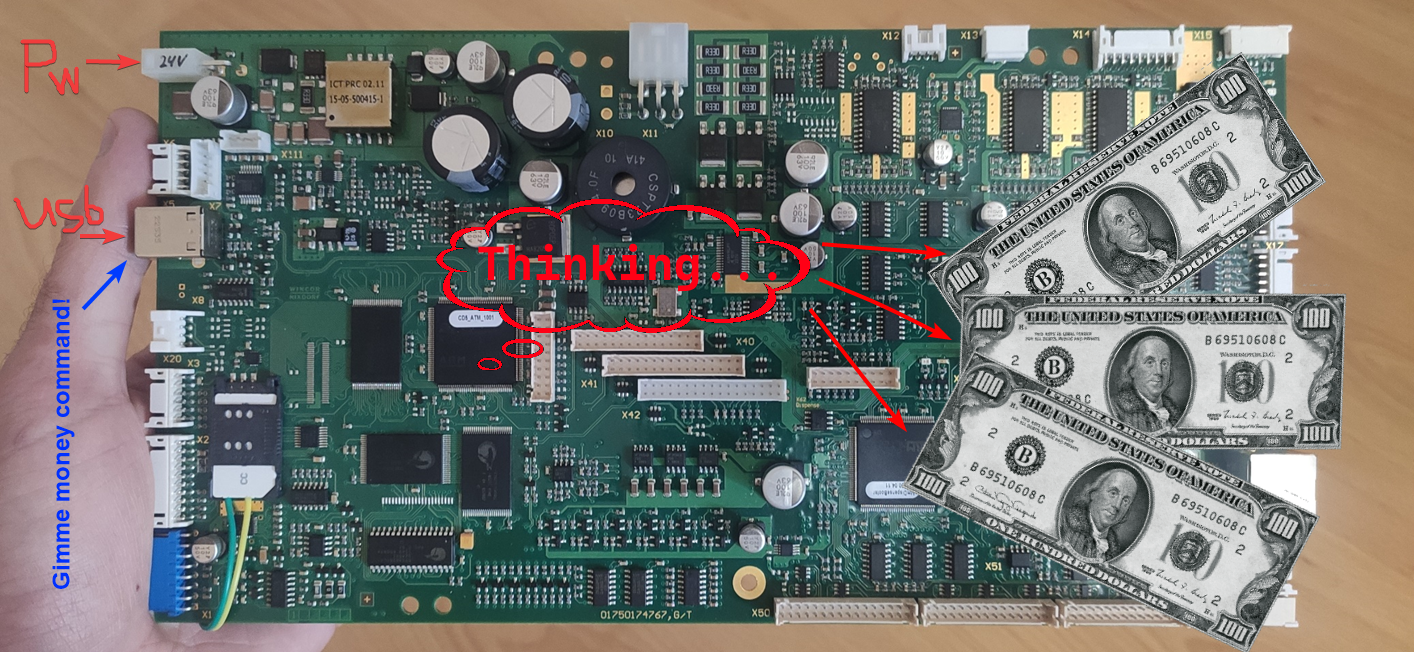
Hi there! A while ago, Positive Technologies published the news that ATMs manufactured by Diebold Nixdorf (previously known as Wincor), or more specifically, the RM3 and CMDv5 cash dispensers, contained a vulnerability which allowed attackers to withdraw cash and upload modified (vulnerable) firmware. And since my former colleague Alexei Stennikov and I were directly involved in finding this vulnerability, I would like to share some details.

Read more

How to detect a cyberattack and prevent money theft

Reading time12 min
Reach and readers2.9K

Money theft is one of the most important risks for any organization, regardless of its scope of activity. According to our data, 42% of cyberattacks on companies are committed to obtain direct financial benefits.  You can detect an attack at various stages—from network penetration to the moment when attackers start withdrawing money.  In this article, we will show how to detect an attack at each of its stages and minimize the risk, as well as analyze two common scenarios of such attacks: money theft manually using remote control programs and using special malware—a banking trojan.

Read more

Positive Technologies Brings ‘Hackable City’ to Life in The Standoff Cyberbattle at HITB+ CyberWeek

Reading time2 min
Reach and readers1.8K
Attackers and defenders to face off in digital metropolis security challenge featuring real-world critical infrastructure and technologies.


Cybersecurity experts at Positive Technologies and Hack In The Box are inviting red and blue team security specialists to test their skills attacking and defending a full-scale modern city at The Standoff Cyberbattle held during HITB+ CyberWeek. This mock digital metropolis with full IT and OT infrastructure including traffic systems, electrical plants, and transportation networks will feature all the latest technologies used in actual critical infrastructure installations, allowing players to expose security issues and the impact they might have on the real world.
Read more →

Detecting Web Attacks with a Seq2Seq Autoencoder

Reading time7 min
Reach and readers6.6K
image

Attack detection has been a part of information security for decades. The first known intrusion detection system (IDS) implementations date back to the early 1980s.

Nowadays, an entire attack detection industry exists. There are a number of kinds of products—such as IDS, IPS, WAF, and firewall solutions—most of which offer rule-based attack detection. The idea of using some kind of statistical anomaly detection to identify attacks in production doesn’t seem as realistic as it used to. But is that assumption justified?
Read more →

Information

Company name
Акционерное общество «Позитив Текнолоджиз»
Tax ID
7718668887
Website
www.ptsecurity.com
On Habr since
Registered
2002
Employees
1,001–5,000 employees
Location
Россия