Popular science
Popular science as is
Novel Coronavirus nCOV/2019-nCoV/NCP/COVID19: Forecasts, Statistics, Protection, News,[4th reprint, 06.03|
Translated by authorNovel Coronavirus nCOV/2019-nCoV/NCP/COVID19: Forecasts, Statistics, Protection, News, World: ~2500 [4th reprint, 28.02]
In Chinese
https://hmp.me/cxq9
Incomplete data for the entire period
New news
Updated Charts for 2019-nCov
I started creating my own site, everything new will be on it.
A tour of the Museum of Optics at ITMO University
Bandwidth warning: lots of photos below!

Post-cyberpunk: what you need to know about the latest trends in speculative fiction

Weekend Picks: light reading for STEM majors

Holographic Principle, new type gyroscope, information without light speed limit, teleportation of physical objects…
First, all the objects and theories described in this article have the status of hypothetical at the moment. That is, the holographic hypothesis and string theories have not been experimentally confirmed many.
Second, a fundamentally new type of mechanical gyroscope with six degrees of freedom is proposed for experimental verification (base) of hypotheses. Of the two and three degrees of freedom mechanical gyroscopes known to science, this is the last of the possible types with the maximum number of degrees of freedom in the holonomic system (GYRO_6DoF).
Third, with the advent of the experimental base — the tops of the physical pyramid, string theories, and the holographic hypothesis, which is actually the foundation of the future Theory of Everything, are temporarily removed from criticism until the moment of practical implementation of the experiment and measurements.
Abstract
Even people far from physics know that the maximum possible data transmission rate of any signal is equal to the speed of light in a vacuum. It is denoted by the letter «c», and this is about 300 thousand kilometers per second. The speed of light in a vacuum is one of the fundamental physical constants. The impossibility of achieving speeds exceeding the speed of light in three-dimensional space is a deduction from Einstein's Special Theory of Relativity (SRT). Usually, when it is argued that SRT prohibits the transmission of the information above the speed of light, an implicit assumption is made that there is no other way other than to «bind information» to a photon and transmit it. However, there is another way. The well-known physical hypothesis — the Holographic Principle (a modern and widely used tool in theoretical physics) points to an interesting phenomenon: “Phenomena taking place in three-dimensional space can be projected onto a remote screen without losing information” — Leonard Susskind “The World as a Hologram ”[p. 3].

The color of the Moon and the Sun from space in terms of RGB and color temperature
It would seem that the question of the color of the Moon and the Sun from space for modern science is so simple that in our century there should be no problem at all with the answer. We are talking about colors when observing precisely from space, since the atmosphere causes a color change due to Rayleigh light scattering. «Surely somewhere in the encyclopedia about this in detail, in numbers it has long been written,» you will say. Well, now try searching the Internet for information about it. Happened? Most likely no. The maximum that you will find is a couple of words about the fact that the Moon has a brownish tint, and the Sun is reddish. But you will not find information about whether these tints are visible to the human eye or not, especially the meanings of colors in RGB or at least color temperatures. But you will find a bunch of photos and videos where the Moon from space is absolutely gray, mostly in photos of the American Apollo program, and where the Sun from space is depicted white and even blue.Especially my personal opinion is nothing but a consequence of the intervention of politics in science. After all, the colors of the Moon and the Sun from space directly relate to the flights of Americans to the Moon.
I searched through many scientific articles and books in search of information about the color of the Moon and the Sun from space. Fortunately, it turned out that even though they do not have a direct answer to RGB, there is complete information about the spectral density of the solar radiation and the reflectivity of the Moon across the spectrum. This is quite enough to get accurate colors in RGB values. You just need to carefully calculate what, in fact, I did. In this article I will share the results of calculations with you and, of course, I will tell you in detail about the calculations themselves. And you will see the Moon and the Sun from space in real colors!
Hell or high water: history of Russian popular science literature

The available and interesting literature on science is a magic wand that helps the progress not to slow down and move forward. Thanks to interesting science literature, children begin to study voluntarily and with interest, while adults expand their horizons and do not allow the brain to relax. Biology, astronomy and mathematics supplant the saga about the elves and intergalactic ships. But while Western countries' nonfiction was always in smooth progress from Jules Verne to Eliezer S. Yudkowsky, then opposite it experienced both ups and downs in Russia.
Finally, rejuvenation is a thing

Preface
What is ageing? We can define ageing as a process of accumulation of the damage which is just a side-effect of normal metabolism. While researchers still poorly understand how metabolic processes cause damage accumulation, and how accumulated damage causes pathology, the damage itself – the structural difference between old tissue and young tissue – is categorized and understood pretty well. By repairing damage and restoring the previous undamaged – young – state of an organism, we can really rejuvenate it! It sounds very promising, and so it is. And for some types of damage (for example, for senescent cells) it is already proved to work!
Today in our virtual studio, somewhere between cold, rainy Saint-Petersburg and warm, sunny Mountain View, we meet Aubrey de Grey, again! For those of you who are not familiar with him, here is a brief introduction.
Artificial neural networks explained in simple words

When I used to start a conversation about neural networks over a bottle of beer, people were casting glances at me of what seemed to be fear; they grew sad, sometimes with their eyelid twitching. In rare cases, they were even eager to take refuge under the table. Why? These networks are simple and instinctive, actually. Yes, believe me, they are! Just let me prove this is true!
Suppose there are two things I’m aware of about the girl: she looks pretty to my taste or not, and I have lots to talk about with her or I haven’t. True and false will be one and zero respectively. We’ll take similar principle for appearance. The question is: “What girl I’ll fall in love with, and why?”
We also can think it straight and uncompromisingly: “If she looks pretty and there’s plenty to talk about, then I will fall in love. If neither is true, then I quit”.
But what if I like the lady but there’s nothing to talk about with her? Or vice versa?
Cosmonaut Aleksandr Laveykin about the best space movie, G-force of 20g, and soft landing
Up to now, the Q&A had not been translated into English. We post them for upcoming International Day of Human Space Flight (or Cosmonautics Day in Russia).
Aleksandr Laveykin flew to space in 1987 and worked as a flight engineer on board the Mir Space Station, orbiting the Earth for six months. He completed three spacewalks lasting a total of eight hours and 48 minutes.

Image: TASS
Flightradar24 — how does it work? Part 2, ADS-B protocol

In the first part the basic ideas of operation were described. Now let's go further and figure out, what data is exactly transmitting and receiving between the aircraft and a ground station. We'll also decode this data using Python.
Most common misconceptions in popular physics
I decided to compile a list of the most popular misconceptions. And the winner is...., or course, this one:
The Big Bang
Usually it is pictured like this:

Stonehenge. The secrets of megaliths

They started their work in summer.
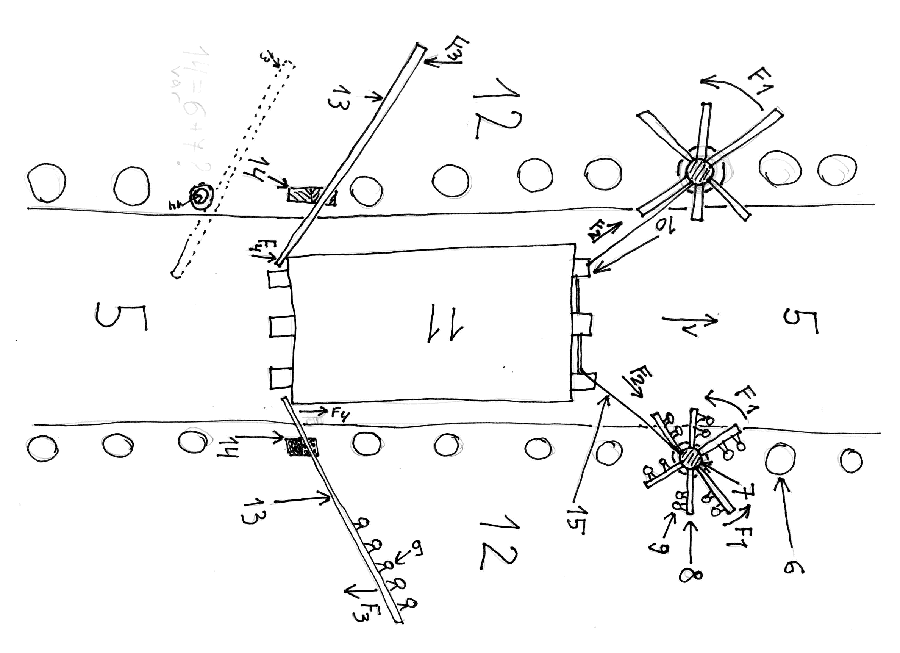
They prepared road for transportation. They needed a clean and glade road without stones and other irregularities. (No.4 on picture)
Perhaps they cut the topsoil and covered the road with clay. (No.3 on the picture)
On each side they made curbs ( 5-10 cm). (No.2 on the picture)
They used clay because they wanted to hold water inside the road.
In autumn rains filled road with water. It looked like a big puddle. (No.5 on the picture)
In winter road froze. Then they got a smooth ice skating rink slightly wider than a megalith.
Megaliths (No.11) were transported in winter.
Mechanism and vehicles for transportation were prepared in summer.
Mechanism consisted of three parts.

How does a barcode work?
Every person is using barcodes nowadays, mostly without noticing this. When we are buying the groceries in the store, their identifiers are getting from barcodes. Its also the same with goods in the warehouses, postal parcels and so on. But not so many people actually know, how it works.
What is 'inside' the barcode, and what is encoded on this image?

Lets figure it out, and also lets write our own bar decoder.
Researchers from MIT designed «rectenna» which converts Wi-Fi signals into electricity

Source: eeNews Europe
I'm glad that Habr got brand new English version. And my first post in English is about new MIT project. Researchers designed an ultra-low capacitance and ultra-low resistance Schottky diode capable of switching at GHz frequencies. This diode is able rectify and convert random WiFi signals into DC electricity.
MoS2 «rectenna» (this is how scientists called their invention) could become the main element of roll-to-roll process to cover a huge areas. To be fair antennas capable transform radio signals in to electricity is not a new thing. The main achievement of MIT engineers is creation of soft rectenna made from special alloy.