Pull to refresh
1359.43

Programming *

The art of creating computer programs

Show first
Period
Level of difficulty

Algorithms in Go: Sliding Window Pattern

Reading time3 min
Reach and readers6.4K

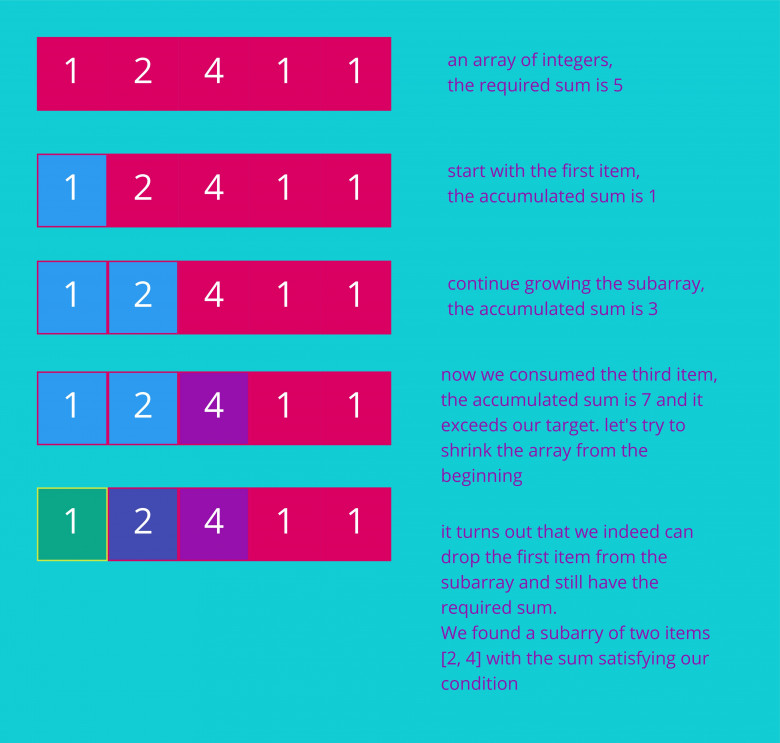
Let's consider the following problem: we have an array of integers and we need to find out the length of the smallest subarray the sum of which is no less than the target number. If we don't have such a subarray we shall return -1.

We can start with a naive approach and consider every possible subarray in the input:

Continue reading

Using Flex (Fast Lexical Analyzer Generator)

Reading time5 min
Reach and readers10K
Lexical analysis is the first stage of a compilation process. It's used for getting a token sequence from source code. It gets an input character sequence and finds out what the token is in the start position, whether it's a language keyword, an identifier, a constant (also called a literal), or, maybe, some error. A lexical analyzer (also known as tokenizer) sends a stream of tokens further, into a parser, which builds an AST (abstract syntax tree).

It's possible to write a lexer from scratch, but much more convenient to use any lexer generator. If we define some parsing rules, corresponding to an input language syntax, we get a complete lexical analyzer (tokenizer), which can extract tokens from an input program text and pass them to a parser.

One of such generators is Flex. In this article, we'll examine how it works in general, and observe some nontrivial nuances of developing a lexer with Flex.
Read more →

Esoteric programming languages: a systematic approach

Reading time6 min
Reach and readers2.6K
A surprising number of programming languages were created to accomplish unusual tasks that have nothing to do with programming. These are commonly called esoteric. Today, we’re going to paint a general overview of the esolang landscape, and try to figure out why people are continuing to create them.

Read more →

[Interview] Top Programming Trends And Practical Advice to Follow in The New Decade

Reading time3 min
Reach and readers2.3K


Image credit: Unsplash

What will the future bring to the programming world? Are there any specific technologies that will rise and fall? Which programming language one should learn to succeed in their career? What should a newbie programmer know and understand to build a successful career in the 2020s?

I had the opportunity to sit down and talk about these issues in greater detail with Vitaly Kukharenko, a CTO with 10+ years of experience and creator of several high load startups.
Read more →

WebRTC streaming in and around virtual reality

Reading time6 min
Reach and readers4.2K


Virtual reality is on the rise these days. The equipment that was previously the exclusive preserve of crazy scientists geeks with big money from the Ministry of Defense back in the The Lawnmower Man days, is currently affordable for ordinary people; those whose pockets are empty, can assemble a VR headset from cardboard and a smartphone according to many recipes.

Read more →

Hyper-V for Developers on Windows 10

Reading time6 min
Reach and readers7.1K
Hyper-V is more known as a server virtualization technology; however, since Windows 8, it is also available in the client operating system. In Windows 10, Microsoft improved the experience drastically to make Hyper-V an excellent solution for developers and IT Pros.
 
Microsoft Hyper-V, codenamed Viridian, is a native (type 1) hypervisor that directly runs on the hardware, compared to VMware Workstation, VirtualBox, and other type 2 or hosted hypervisors. It was first released in Windows Server 2008, and it allows you to run virtual machines on x86-64 systems.

As mentioned, with Windows 10, Microsoft optimized Hyper-V for developers. Hyper-V allows developers to quickly spin up development virtual machines on Windows 10 with excellent performance, but it is also used in a couple of other development features as a back-end technology, like the Android Emulator, the Windows Subsystem for Linux 2 or Docker Containers. In this article, we will have a quick look at what Hyper-V on Windows 10 can over for developers.
Read more →

Quick reference of C++ value categories: Part 2

Reading time41 min
Reach and readers2.9K


Go to Part 1


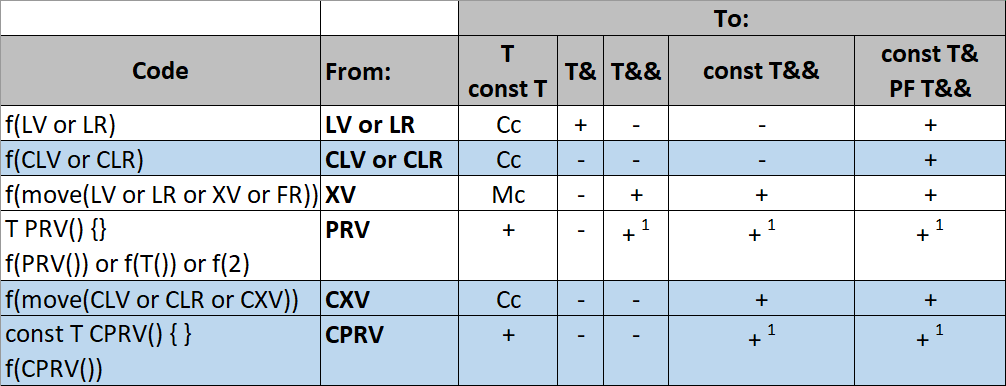
Passing parameters to a function


When passing parameter to a function, category of a passed expression is implicitly converted to the category of function parameter: void f(TO_TYPE p); FROM_TYPE x; f(x); This implicit conversion takes place the same way as during an assignment (see "Assignment" section above) except that function definition cannot contain "auto" types.


Read more →

How to Implement Tinder Swipe Cards in SwiftUI

Reading time7 min
Reach and readers15K
In June, we heard about SwiftUI for the first time — a totally new way of creating and working with UI elements in iOS and macOS (also iPadOS) apps. It felt like Christmas in the summer. It's new, it's declarative, it's sexy! And now, just a few weeks after iOS 13 has been released, we can start to use SwiftUI in all our projects. Let's learn how to use this amazing tool that Apple gave us, to create the classic Tinder-esque Swipe Cards.

In this article, I would like to show you how to achieve a Tinder-like card view and behavior (swipe to action), with just a few lines of code.

To achieve this, we need to do the following things, in order:

  • Create UserView
  • Create NavigationView
  • Create BottomBarView
  • Create SwipeView
  • Put all this together inside ContentView

So let's get started.
Read more →

Python in Visual Studio Code – October 2019 Release

Reading time3 min
Reach and readers3.1K
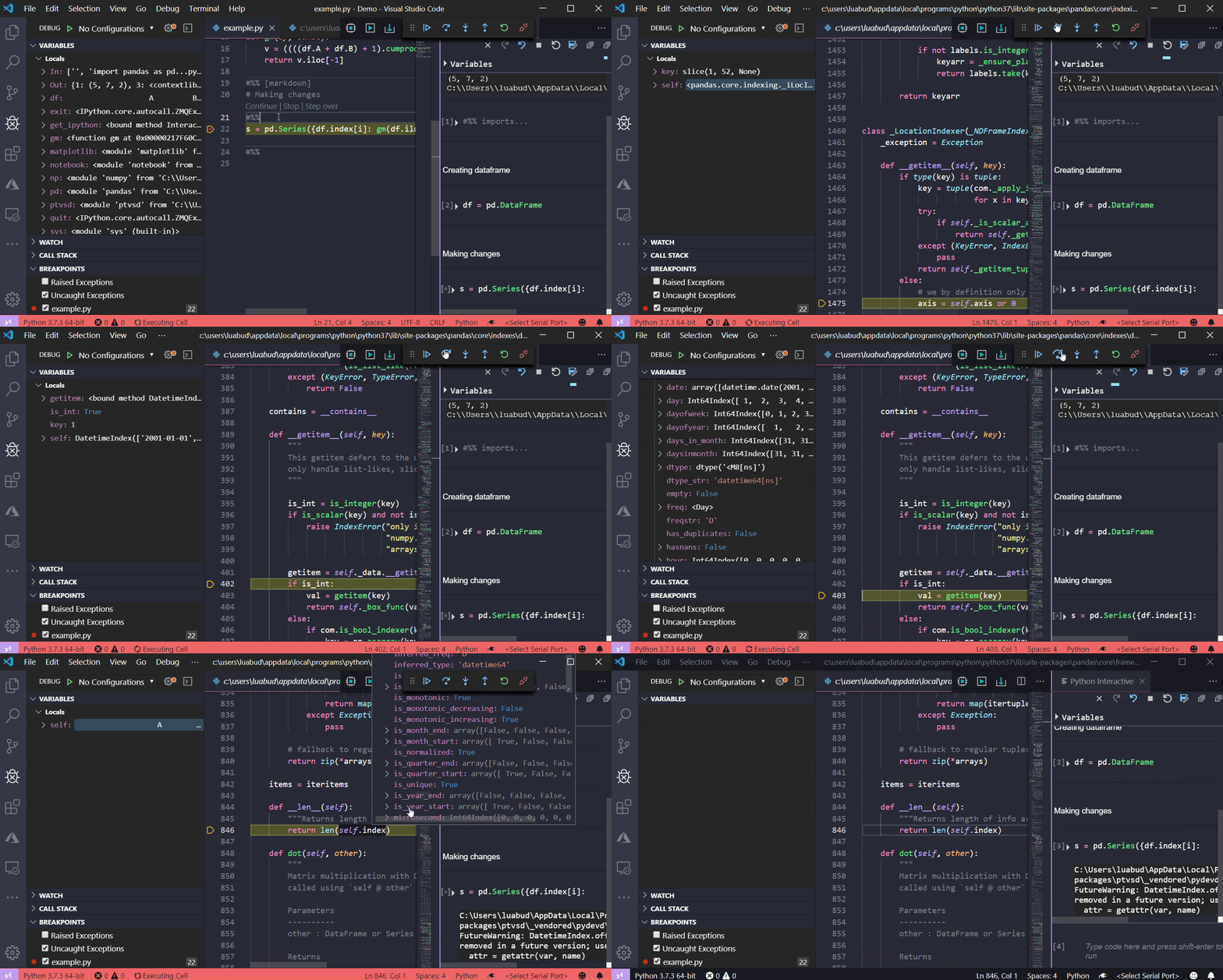
We are pleased to announce that the October 2019 release of the Python Extension for Visual Studio Code is now available. You can download the Python extension from the Marketplace, or install it directly from the extension gallery in Visual Studio Code. If you already have the Python extension installed, you can also get the latest update by restarting Visual Studio Code. You can learn more about  Python support in Visual Studio Code in the documentation.  

In this release we addressed 97 issues, including native editing of Jupyter Notebooks, a button to run a Python file in the terminal, and linting and import improvements with the Python Language Server. The full list of enhancements is listed in our changelog

Read more →

Quintet instead of Byte — data storage and retrieval approach

Reading time13 min
Reach and readers2.2K
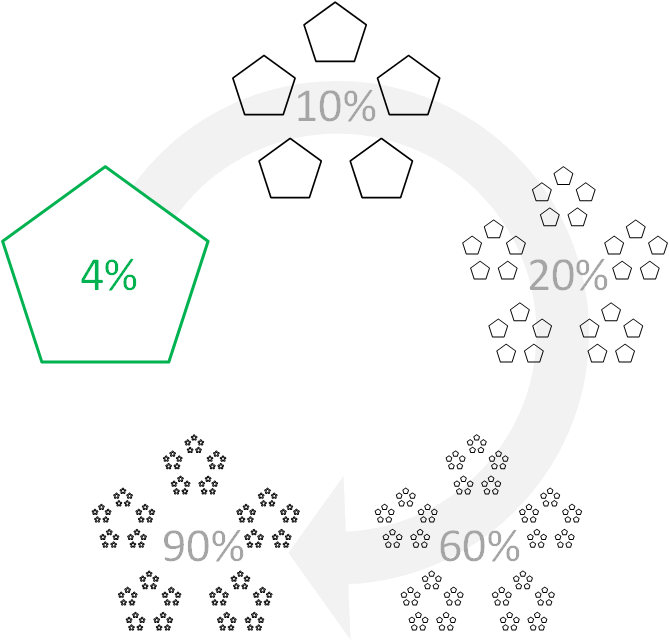
Quintet is a way to present atomic pieces of data indicating their role in the business area. Quintets can describe any item, while each of them contains complete information about itself and its relations to other quintets. Such description does not depend on the platform used. Its objective is to simplify the storage of data and to improve the visibility of their presentation.


We will discuss an approach to storing and processing information and share some thoughts on creating a development platform in this new paradigm. What for? To develop faster and in shorter iterations: sketch your project, make sure it is what you thought of, refine it, and then keep refining the result.

The quintet has properties: type, value, parent, and order among the peers. Thus, there are 5 components including the identifier. This is the simplest universal form to record information, a new standard that could potentially fit any programming demands. Quintets are stored in the file system of the unified structure, in a continuous homogeneous indexed bulk of data. The quintet data model — a data model that describes any data structure as a single interconnected list of basic types and terms based on them (metadata), as well as instances of objects stored according to this metadata (data).
Read more →

Python in Visual Studio Code – September 2019 Release

Reading time3 min
Reach and readers2.9K
We are pleased to announce that the September 2019 release of the Python Extension for Visual Studio Code is now available. You can download the Python extension from the Marketplace, or install it directly from the extension gallery in Visual Studio Code. If you already have the Python extension installed, you can also get the latest update by restarting Visual Studio Code. You can learn more about  Python support in Visual Studio Code in the documentation.

This was a short release where we closed 35 issues, including improvements to the Python Language Server and to Jupyter Notebook cell debugging, as well as detection of virtual environment creation. The full list of enhancements is listed in our changelog

Read more →

Tutorial: Update interfaces with default interface members in C# 8.0

Reading time5 min
Reach and readers1.5K

Beginning with C# 8.0 on .NET Core 3.0, you can define an implementation when you declare a member of an interface. The most common scenario is to safely add members to an interface already released and used by innumerable clients.


In this tutorial, you'll learn how to:


  • Extend interfaces safely by adding methods with implementations.
  • Create parameterized implementations to provide greater flexibility.
  • Enable implementers to provide a more specific implementation in the form of an override.

Read more →

Who put Python in the Windows 10 May 2019 Update?

Reading time3 min
Reach and readers1.9K

Some days ago the Windows team announced the May 2019 Update for Windows 10. In this post we’re going to look at what we, the Python team, have done to make Python easier to install on Windows by helping the community publish to the Microsoft Store and, in collaboration with Windows, adding a default “python.exe” command to help find it. You may have already heard about these on the Python Bytes podcast, at PyCon US, or through Twitter.


The header of the Python 3.7 page in the Microsoft Store
Read more →

The architecture of an exceptional situation: pt.2 of 4

Reading time13 min
Reach and readers1.5K

I guess one of the most important issues in this topic is building an exception handling architecture in your application. This is interesting for many reasons. And the main reason, I think, is an apparent simplicity, which you don’t always know what to do with. All the basic constructs such as IEnumerable, IDisposable, IObservable, etc. have this property and use it everywhere. On the one hand, their simplicity tempts to use these constructs in different situations. On the other hand, they are full of traps which you might not get out. It is possible that looking at the amount of information we will cover you’ve got a question: what is so special about exceptional situations?


However, to make conclusions about building the architecture of exception classes we should learn some details about their classification. Because before building a system of types that would be clear for the user of code, a programmer should determine when to choose the type of error and when to catch or skip exceptions. So, let’s classify the exceptional situations (not the types of exceptions) based on various features.

Read more →

An update to C# versions and C# tooling

Reading time3 min
Reach and readers3.6K

Starting with Visual Studio 2019 Preview 4 and RC, we’ll be adjusting how C# versions are treated in .NET tooling. Read more below <cut>.


Summary of changes


Firstly, we’re adding two new Language Version (LangVersion) values: LatestMajor and Preview. Here’s how they stack up with the currently supported list of values:

Read more →

Announcing the Open Sourcing of Windows Calculator

Reading time2 min
Reach and readers1.2K

Today, we’re excited to announce that we are open sourcing Windows Calculator on GitHub under the MIT License. This includes the source code, build system, unit tests, and product roadmap. Our goal is to build an even better user experience in partnership with the community. We are encouraging your fresh perspectives and increased participation to help define the future of Calculator.


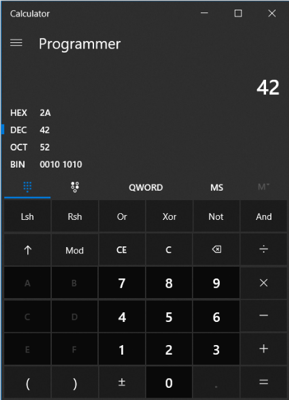
Image of Windows Calculator

Read more →

AGENTS.md: The README for Your AI Agent

Level of difficultyEasy
Reading time3 min
Reach and readers13K

If you’re like me and work with multiple AI coding agents, you know the frustration of managing different instruction files. It’s a pain to keep everything updated across various formats. But I’ve got some great news for you. A new, simplified standard has emerged, and it’s called AGENTS.md.

Read more

Google ADK: Easiest Way to Build an AI Agent

Level of difficultyEasy
Reading time7 min
Reach and readers2.8K

In this tutorial, I’ll explain in simple terms what AI, AI agents, and workflows are, and then I’ll walk you through building your very first AI agent in Python using Google’s Agent Development Kit (ADK). By the end, you’ll understand the differences between these concepts and have a working content-assistant agent you can run from your terminal or a web interface.

Read more

These Tools helped me become x10 faster Web Developer

Reading time3 min
Reach and readers5.7K

In this article, I'd like to share my top 5 tools that have helped me become more efficient and faster as a web developer. You may already use some of these tools, but others could be new. Read the article to the end to make sure you don't miss the most essential tool :).

Read more

Review of mini-book «60 terrible tips for a C++ developer»

Level of difficultyEasy
Reading time6 min
Reach and readers1.9K

I wrote a small e-book about terrible tips for C++ developers. Actually, it describes bad programming practices and explains why it's better to avoid them. However, every chapter of this mini-book starts with a terrible tip — just for fun.


60 terrible tips for a C++ developer


By the way, these tips may seem artificial but believe me, they are based on the real experience. In other words, the described terrible tips occur in developers' lives — that's why it's worth discussing them. First of all, this book will be useful for junior developers. But more skilled C++ developers can also find interesting and useful tips.


Even though it's a mini-book, it clearly does not fit into the Habr format. Too many words. So, I decided to write here the review. Here is the link to find the full version of the mini-book: 60 terrible tips for a C++ developer.


If you still hesitate whether to read it or not, below you will find a list of terrible tips that will be discussed in the mini-book.


View the terrible tips:

Read more →

Authors' contribution